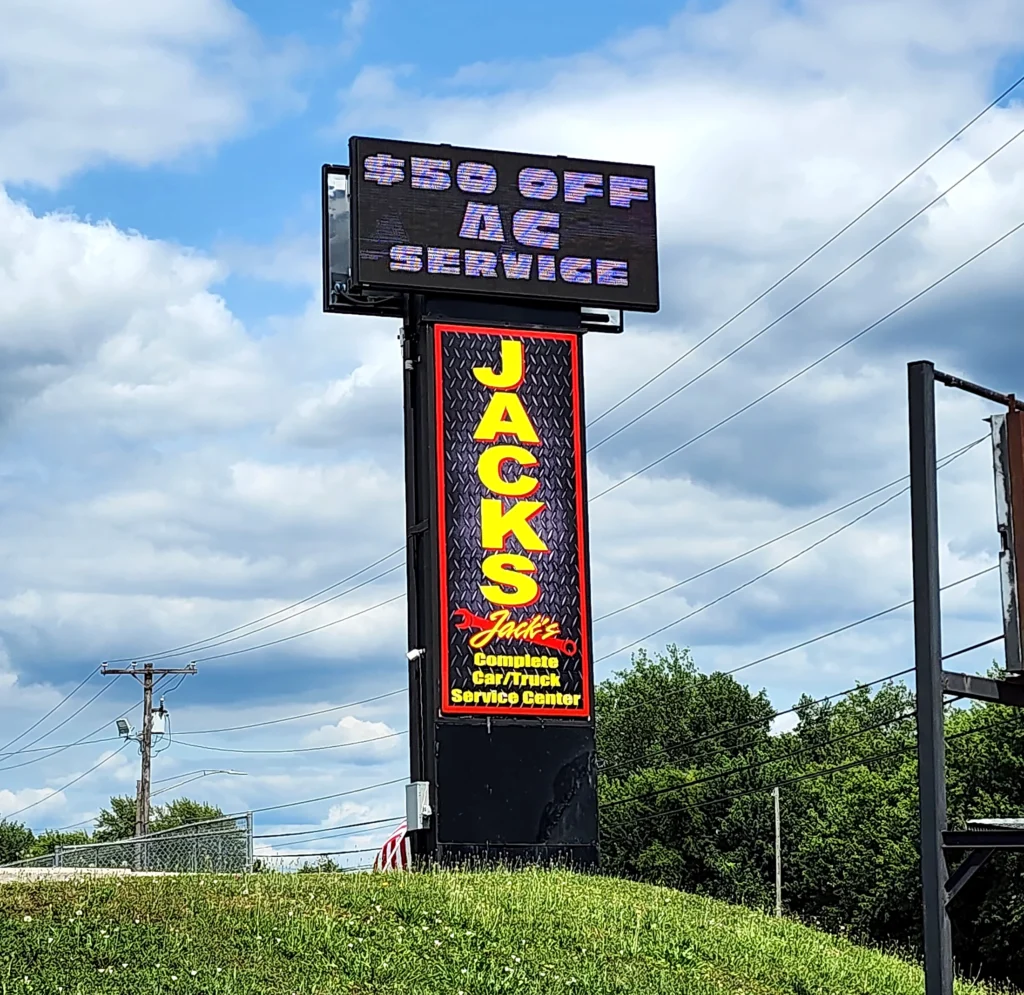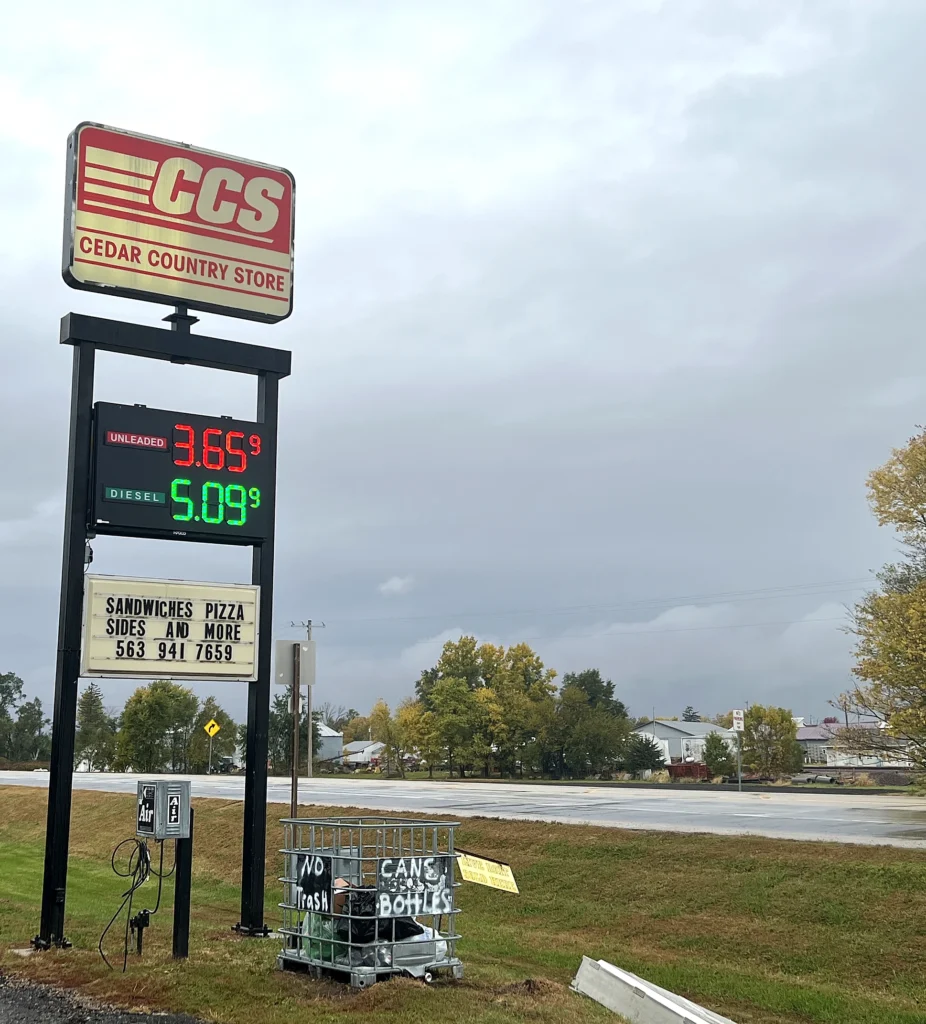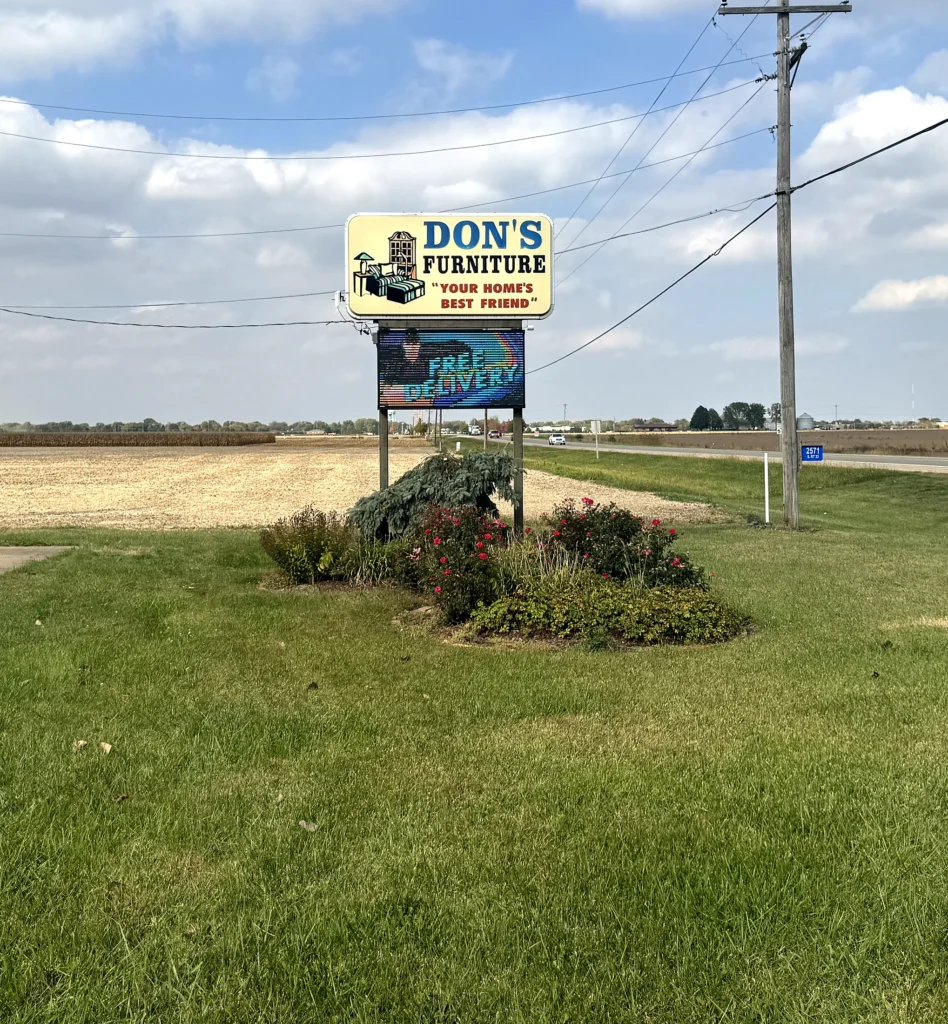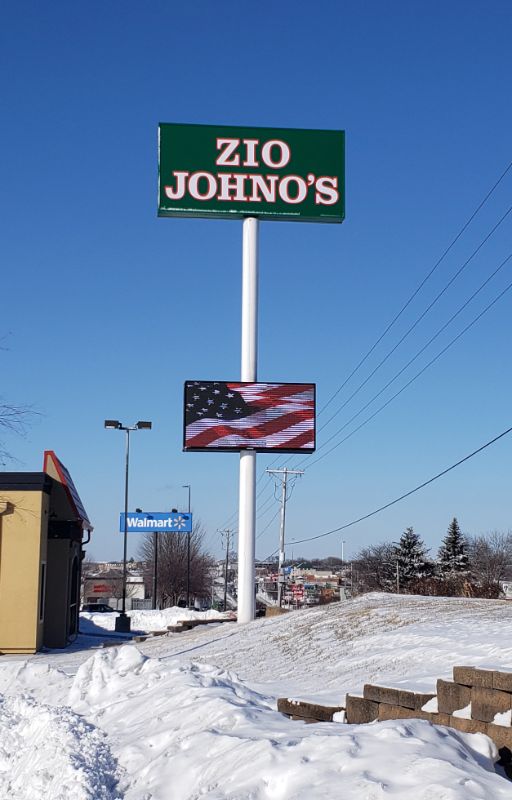
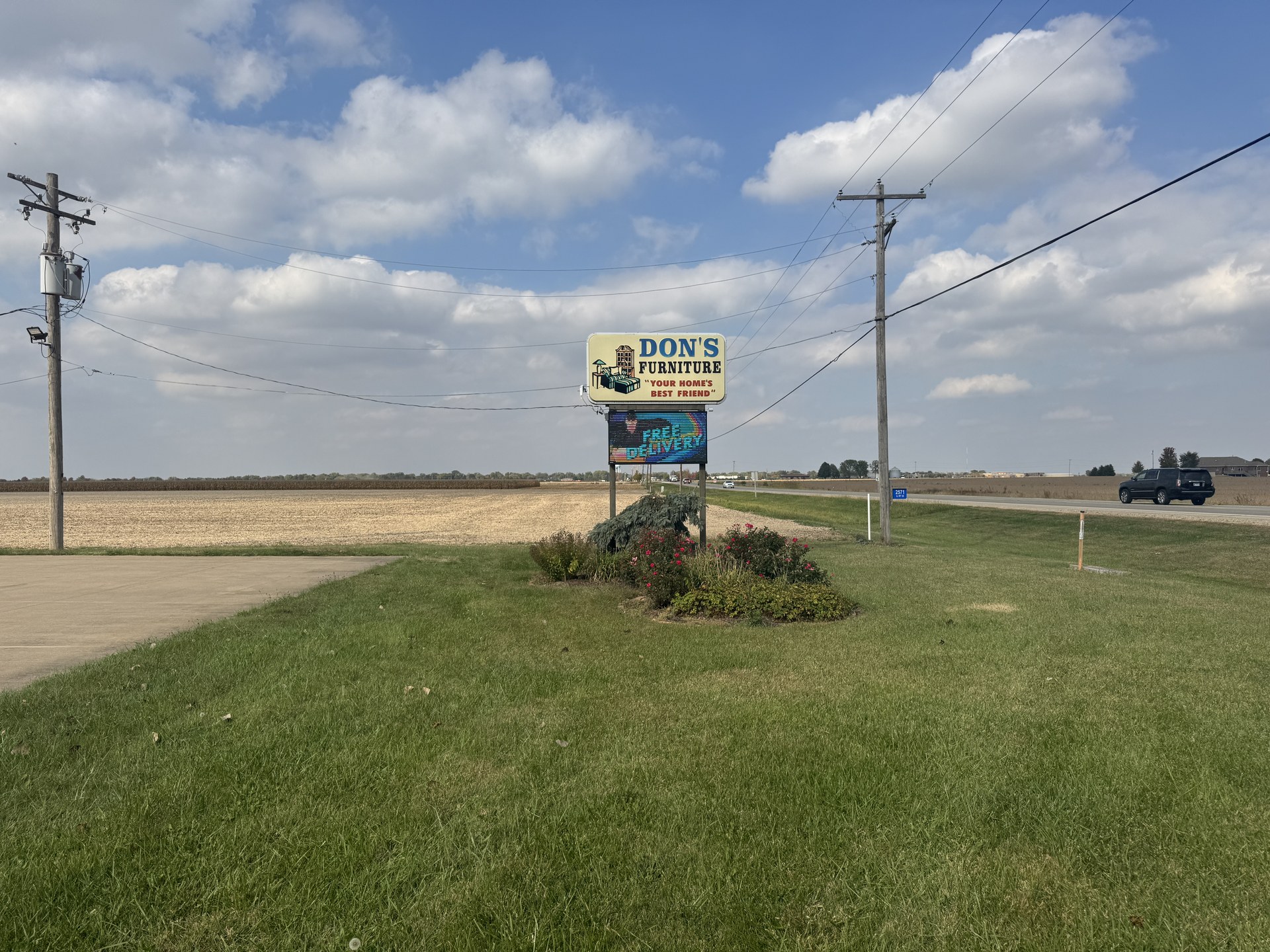
When is a pylon sign the right choice over a monument?
Choose a pylon when drivers need to find you from far back on a road at 45 mph or faster, when the building sits deep on the lot, or when several tenants share one sign. Choose a monument when traffic is slow, the entrance is close to the road, or the code caps height.
A pylon's advantage is detection distance. USSC research gives drivers on high-speed multi-lane roads 11 to 12 seconds to notice, read and react, which at 55 mph is close to 900 to 1,000 feet of road. A low sign can disappear behind traffic over that distance.
A pylon is not automatically better. It costs more, needs engineering and a bigger footing, and many zones do not allow one. If your customers arrive at 25 mph on a two-lane street, a well-lit monument may do the job for less.
| Site condition | Leans pylon | Leans monument |
|---|---|---|
| Road speed | 45 mph and up, multi-lane | Under 35 mph, two to three lanes |
| Building setback | Deep lot, building hard to see | Building visible from the road |
| Tenants | Several tenants on one structure | One business or a short list |
| Local height limit | Zone allows 20 ft or more | Zone caps freestanding signs low |
| Obstructions | Trees, parked trucks, grade changes | Clear, level approach |
| Budget | Room for engineering and a large footing | Simpler footing, lower structure cost |
Sources: United States Sign Council - Sign Legibility Rules of Thumb (2006)
How tall can a pylon sign be?
As tall as your local code allows, and no taller than drivers can comfortably see. Code limits vary by zone. Spokane, for example, allows 35 feet in general commercial and industrial zones and 20 feet in several neighborhood commercial zones. USSC research ties useful height to detection distance.
Spokane's code also shows how the numbers work in practice: the height limit applies to the combined sign face and structure, and the allowed sign area is one square foot per foot of arterial frontage. That is one city's example. Ask your zoning office for yours.
Height has a visibility ceiling too. USSC guideline standards use a five-degree vertical limit from the driver's eye; with initial detection at 400 feet, that works out to a sign height of about 38.5 feet. Much taller and the sign sits above the windshield view as drivers get close.
Clearance is the other height number. Where a sign extends over a drive or parking area, Spokane requires at least 14 feet under the structure. Check the path of delivery trucks and snowplows before you set the bottom of the cabinet.
Sources: City of Spokane, WA - Municipal Code 17C.240.230, Standards in the Commercial and Industrial Zones (one city's example); USSC Foundation - On-Premise Signs Guideline Standards (2018); City of Spokane, WA - Municipal Code 17C.240.240, Sign Placement and Location Restrictions (one city's example)
How big should a pylon's letters and cabinet be?
Work from letter height, not cabinet size. At 45 mph on a four-lane road, USSC rules of thumb call for capital letters of about 22 inches; at 55 mph on a multi-lane road, about 30 to 32 inches. The cabinet then has to hold those letters with at least 60 percent open background.
Research-based sizes often exceed what codes allow. USSC's broad sign-size equation, at 50 mph with a 10-second reaction time, produces a sign of about 312 square feet. Spokane caps freestanding signs at 250 square feet even in its most permissive zones. When the code wins, cut words, not letter height.
Stack the copy in reading order. The business or center name goes at the top where it is seen first. A message center or tenant panels go below it. Phone numbers and long service lists rarely survive at highway speed.
| Road and speed | USSC reaction time | Distance covered in that time | Capital letter height |
|---|---|---|---|
| 25 mph, two to three lanes | 8 seconds | About 294 ft | About 10 in |
| 30 mph, two to three lanes | 8 seconds | About 353 ft | About 12 in |
| 45 mph, four to five lanes | 10 seconds | About 662 ft | About 22 in |
| 55 mph, multi-lane | 11 to 12 seconds | About 889 to 970 ft | About 30 to 32 in |
Sources: United States Sign Council - Sign Legibility Rules of Thumb (2006); City of Spokane, WA - Municipal Code 17C.240.230, Standards in the Commercial and Industrial Zones (one city's example)
What holds a pylon sign up, and how is it engineered for wind?
Steel supports set in a concrete footing carry the cabinets, and a cover wraps the supports. The footing and steel are sized for local wind, which the International Building Code sets through ASCE 7. Most codes require stamped structural drawings for a pylon.
Wind pressure on a tall sign face is the main load. Because design wind speeds vary by location, the same sign can need a heavier pole or deeper footing in one county than another. HomeGuide notes that engineers typically charge $500 to $3,000 for sign plans and drawings.
Single-pole and two-pole designs each have trade-offs. A single pole keeps the footprint small; two poles spread the load for wider cabinets. The cover can be aluminum, masonry veneer or another finish that matches the building. Soil conditions found during digging can change the footing, so ask how the quote handles that.
Keep every support on your own property. Spokane, for example, allows some sign faces to project into the right-of-way but requires all supports of a freestanding sign to stand on private property.
Sources: International Code Council - Demystifying Loads: 2024 IBC and ASCE 7-22 (IBC Section 1609.1.1); HomeGuide - How Much Does a Business Sign Cost? (Dec. 19, 2023); City of Spokane, WA - Municipal Code 17C.240.243, Freestanding Signs (one city's example)
Should you add an LED message center to a pylon?
Add one if you have messages that change and someone to run them. On a pylon, drivers read from farther away, so a wider pixel pitch is usually enough, and it costs less than a fine one. Check how much of the sign your code lets the display occupy.
Spokane, for example, limits a message center in its general commercial zones to half the allowed sign area or 48 square feet, whichever is less. Many cities also require automatic dimming and cap night brightness at 0.3 footcandles above ambient light, the International Sign Association's recommendation.
AVIXA's visual acuity formula (pitch x 3,438) puts the distance at which a 20/20 viewer stops seeing individual pixels at about 180 feet for a 16 mm display. Drivers closer than that can still read large text, but photos look grainy. On a pylon near a slow parking lot entrance, a finer pitch may read better.
If a pylon already stands, a message center can sometimes be added to it, but the structure has to be checked for the added weight and wind area. Suntronix builds full-color LED message centers and includes on-site software training with every digital sign order.
Sources: AVIXA (Audiovisual and Integrated Experience Association) Xchange - What is Pixel Pitch? How to Calculate Pixel Pitch; City of Spokane, WA - Municipal Code 17C.240.247, Electronic Message Center Signs (one city's example); International Sign Association - EMC Brightness Level Recommendations
Can you reuse an existing pylon structure?
Often, and it is the cheaper path when the steel and footing are sound. New faces or cabinets can go on old poles. The risks are hidden corrosion, old wiring, and codes that treat an oversized older sign as nonconforming, which can limit what you change.
Nonconforming status is the question to ask first. Spokane's code, for example, treats existing message centers in its downtown zones as nonconforming signs subject to a separate section of the code. Other cities limit how much of a nonconforming sign you can alter before it must meet today's rules.
A face or cabinet replacement may still need a permit. Panguitch, Utah, for example, requires a permit for the alteration or replacement of any sign.
Sources: City of Spokane, WA - Municipal Code 17C.240.247, Electronic Message Center Signs (one city's example); Panguitch City, UT - Signage Permit and sign requirements (one city's example)
What drives the cost of a pylon sign?
Height, face area, the number of cabinets, lighting, an LED display, engineering and the footing drive the price. National guides put pylons from about $10,000 to $100,000 or more installed, and up to $200,000 for a large lighted double-sided sign visible from a highway.
These are third-party national estimates, not Suntronix pricing. They move with steel prices, crane access, soil and local labor.
- Overall height and the crane or lift needed to set it.
- Face area and whether the sign is single- or double-sided.
- Number of cabinets or tenant panels.
- Full-color LED message center size and pitch.
- Engineering, footing size and soil conditions.
- Trenching and electrical service to the sign.
| Item | Published range | Source |
|---|---|---|
| Pylon sign, installed | $10,000 to $100,000+ | HomeGuide |
| Large lighted double-sided highway pylon | Up to $200,000 | HomeGuide |
| Pylon and pole signs, most sizes | $20,000 to $100,000 | HomeAdvisor |
| Outdoor LED and digital signs | $750 to $30,000 | HomeAdvisor |
| Structural engineering plans | $500 to $3,000 | HomeGuide |
| Building permit | $400 to $2,500 | HomeAdvisor |
Sources: HomeGuide - How Much Does a Business Sign Cost? (Dec. 19, 2023); HomeAdvisor - How Much Does Commercial Sign Installation Cost? (updated June 20, 2026)
What happens between the quote and a standing pylon?
A site survey, design and pricing, landlord or owner approval, engineering, permits, fabrication, footing, setting the structure and wiring. Engineering and permit review usually set the pace, and both depend on your jurisdiction, so ask the permit office about current review times early.
Suntronix can coordinate permitting and installation for a fee, work with its installer network, or provide the sign and project information your own installer needs.
- Site survey: speeds, sight lines, setbacks, overhead lines, utilities, power source.
- Design and pricing, including cabinet layout and any message center.
- Structural engineering for the steel and footing.
- Sign and electrical permits.
- Fabrication of cabinets, faces, cover and display.
- Utility locates, then footing excavation and concrete.
- Setting the structure, wiring, and training for digital signs.
What should you have ready for a pylon quote?
The address, photos of both approaches from where drivers first see the property, speed limit and lane count, frontage length, any existing pole or footing, tenant list, logo files and landlord criteria. Frontage length matters because many codes tie sign count and area to it.
Spokane, for example, allows one freestanding sign per site or per 300 feet of arterial frontage in its general commercial zones. Knowing your frontage lets the conversation start from what is allowed.
- Photos of both approaches, taken safely by a passenger.
- Speed limit, lane count and the distance at which the property first comes into view.
- Street frontage length along each road.
- Existing pole, footing and power, with any old permit drawings.
- Overhead power lines or trees near the proposed spot.
- Logo files; the quote form takes JPG, PNG or PDF up to 5 MB.