What is a pole sign, and how does it compare with pylon and monument signs?
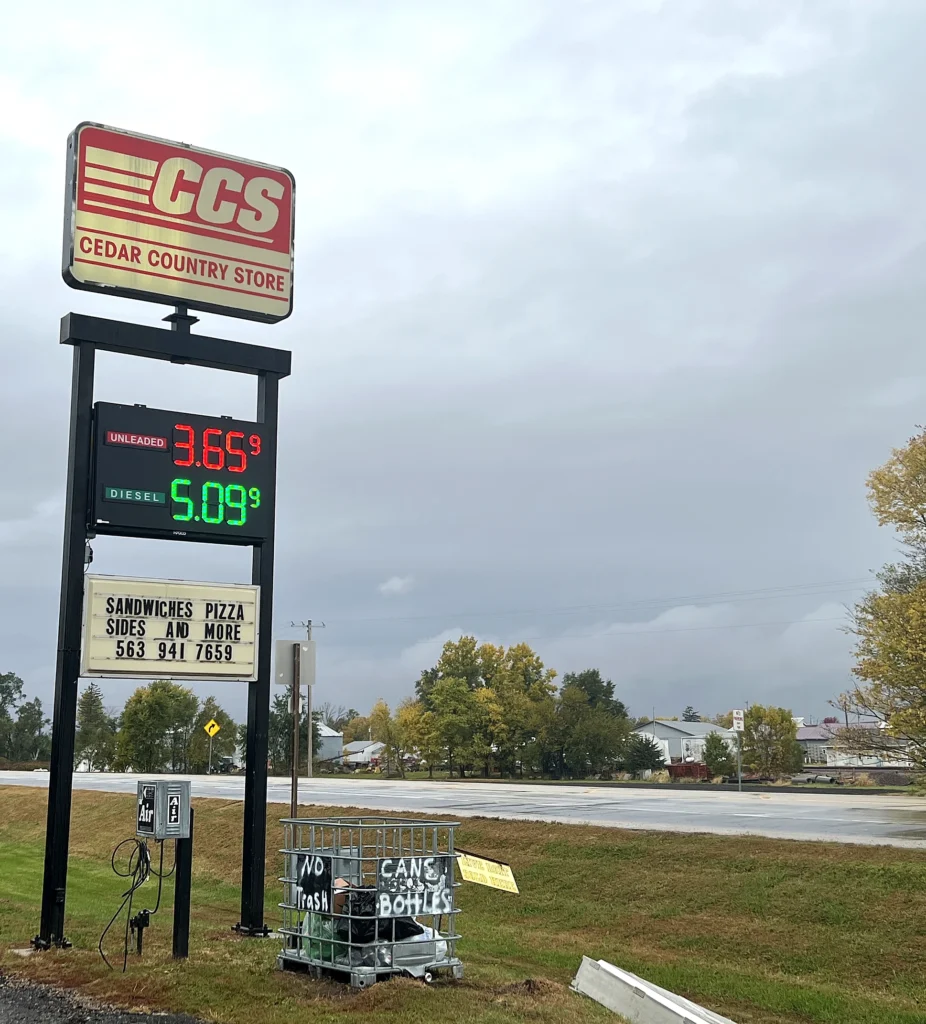
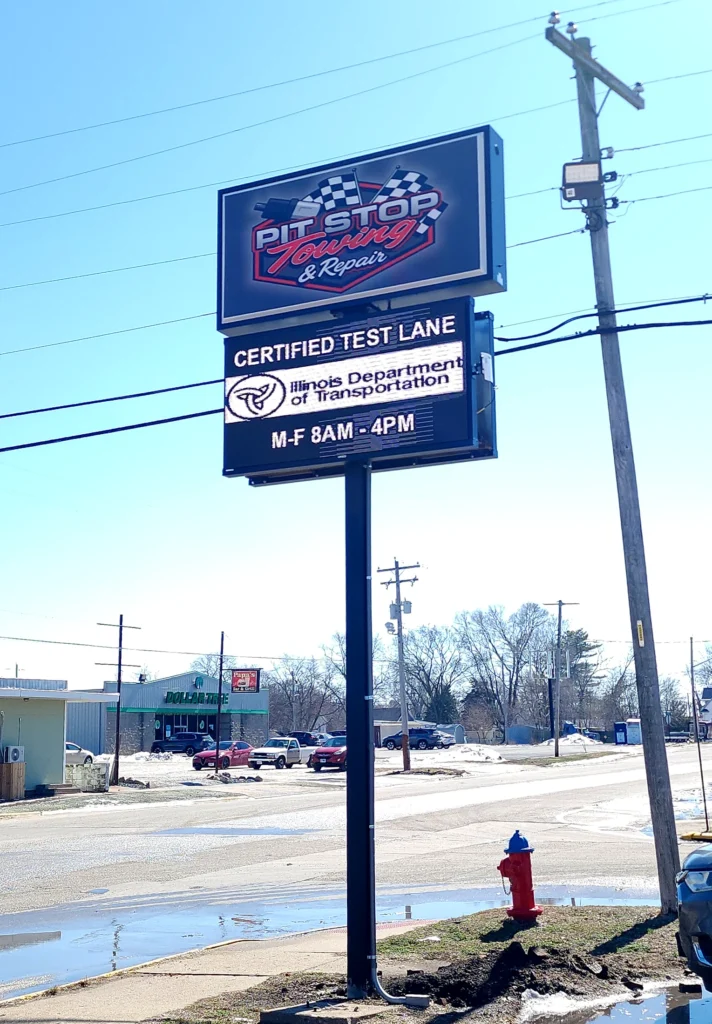
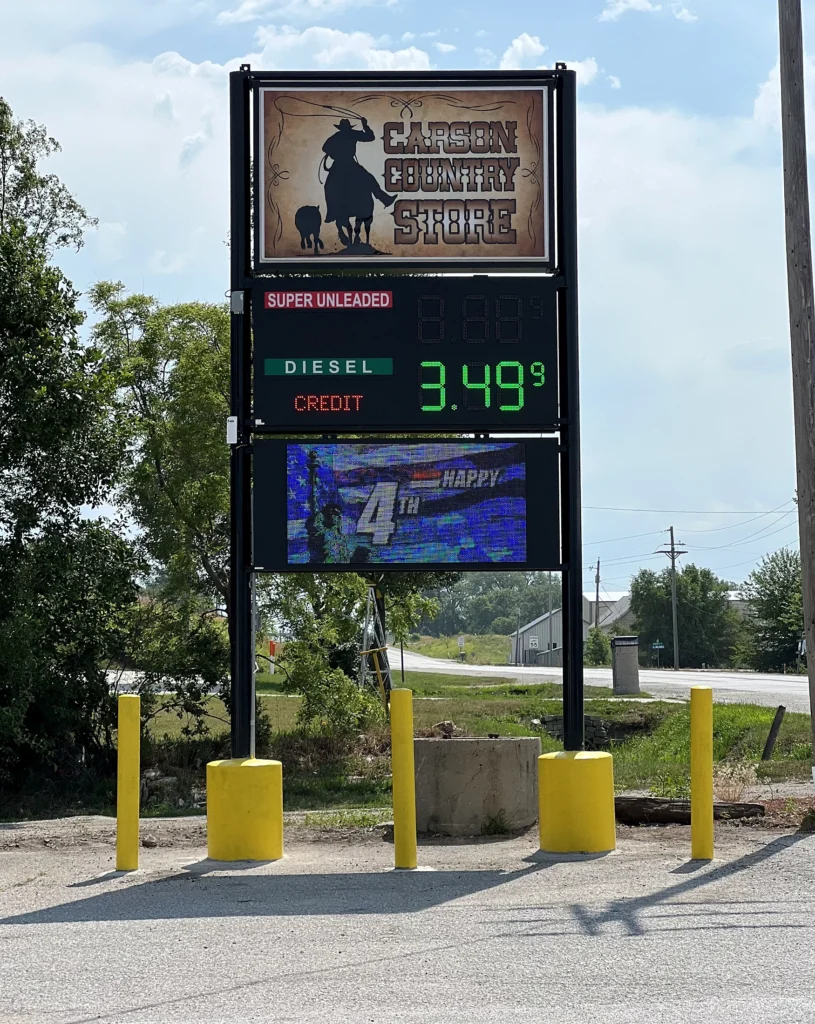
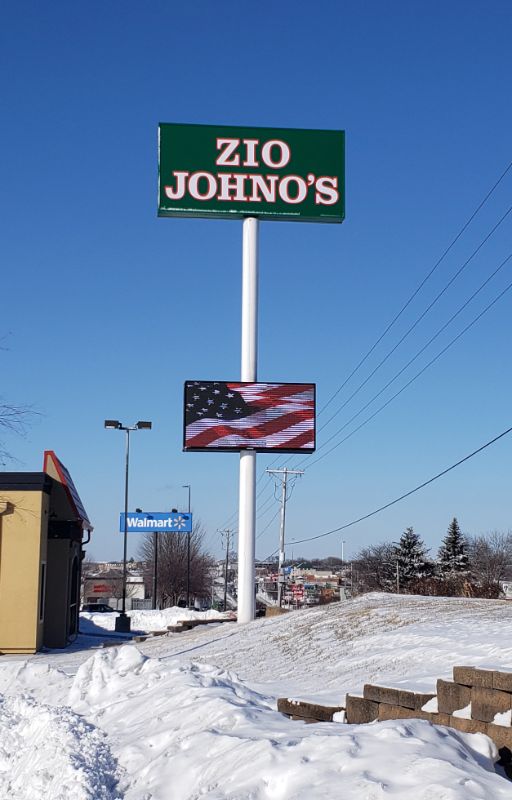
A pole sign stands on exposed poles. A pylon wraps its supports in a cover so the structure reads as one piece, and a monument sits on a solid base at grade. The USSC model sign code files pole signs under freestanding signs and defines a pole or pylon cover as an enclosure that conceals the supports.
Local definitions can be blunt. Des Moines, Iowa's 2014 sign ordinance defined a pole sign as any freestanding sign that is neither a portable sign nor a monument sign, then prohibited pole signs citywide. Under a definition like that, a lightly covered pylon can still count as a pole sign, because only a solid-base monument escapes it.
Choosing between the three formats mostly comes down to road speed, setback and budget, which the pylon signs and monument signs guides cover. This guide covers what is specific to pole signs: the structure, clearance, reuse of an existing pole, and the rules on older signs.
Sources: USSC Foundation - Model On-Premise Sign Code (a model, not law); HomeGuide - How Much Does a Business Sign Cost? (Dec. 19, 2023); City of Des Moines, IA - Ordinance No. 15,290, freestanding sign overlay district (passed June 23, 2014; one city's example, check the current code)
Should a pole sign stand on one pole or two?
A single pole suits a compact cabinet on a tight spot. Two poles carry a wider cabinet, or a cabinet with a message center below it, and change the look. Portsmouth, Rhode Island's design guidelines discourage top-heavy signs on poles and note that twin posts help reduce that appearance.
The structure is set by engineering, not by eye. The building code's formula for posts embedded in earth works from the applied lateral force, the height above ground where that force acts, and the soil's allowable lateral bearing pressure. Raise the same cabinet higher, or add face area that catches more wind, and the design calls for more embedment.
Poles can also carry the wiring. Under the National Electrical Code, poles used to support signs can contain the circuit conductors when the installation meets the code's pole requirements.
Sources: Town of Portsmouth, RI - Code Chapter 148, Design Guidelines, Article VIII Signage Design Guidelines (one town's example); California Building Code 2025 (based on the International Building Code), Section 1807.3 Embedded Posts and Poles, via GoCodebook; EC&M - NEC Rules for Electric Signs and Outline Lighting (NEC Article 600; March 18, 2013)
How tall can pole signs be, and how much clearance do they need?
Your zoning code sets the height, and it varies widely. Spokane, Washington allows 35 feet in its general commercial zones and 20 feet in several smaller ones, while Apex, North Carolina treated pole-mounted signs over 12 feet as nonconforming. Underneath, plan on at least 14 feet where vehicles drive or park.
Some cities go further. Des Moines's 2014 ordinance prohibited pole signs and required freestanding signs to be monuments no taller than 8 feet within 25 feet of the front lot line and 15 feet farther back. These are single-city examples; ask your zoning office for the rules at your address.
Clearance comes from two directions. The USSC model sign code calls for the bottom of a sign to be at least 14 feet above areas where vehicles travel or park, and 8 feet above a sidewalk it overhangs by more than 12 inches. The National Electrical Code separately requires an electric sign to be at least 14 feet above vehicle areas unless it is protected from physical damage.
Taller is not always better. Researchers cited in the USSC guideline standards use a five-degree vertical limit on the driver's view; with initial detection at 400 feet, that limits sign height to 38.5 feet.
Sources: USSC Foundation - Model On-Premise Sign Code (a model, not law); City of Des Moines, IA - Ordinance No. 15,290, freestanding sign overlay district (passed June 23, 2014; one city's example, check the current code); EC&M - NEC Rules for Electric Signs and Outline Lighting (NEC Article 600; March 18, 2013); City of Spokane, WA - Municipal Code 17C.240.230, Standards in the Commercial and Industrial Zones (one city's example); Town of Apex, NC - Unified Development Ordinance Article 10, Sec. 10.6 Nonconforming Signs (Jan. 10, 2023; one town's example); USSC Foundation - On-Premise Signs Guideline Standards (2018)
What foundation and engineering does a pole sign need?
A pole sign is a tall lever in the wind, so pole size and footing come from engineering for your site. The building code sets wind loads through ASCE 7, and HomeGuide notes codes may require stamped structural drawings. HomeGuide puts engineering plans at about $500 to $3,000.
The design pulls together local design wind, the sign's face area and height, and the soil. The California Building Code, which follows the International Building Code, sends embedded pole designs to its embedded-post section or to ASABE EP 486.3. Soil found while digging can change the footing, so ask how a quote handles that.
Keep every support on your own property. Spokane, for example, requires all supports of a freestanding sign to be on private property.
Suntronix provides the drawings and specifications a permit application needs, and can coordinate permitting and installation for a fee or hand that information to your preferred local installer.
Sources: HomeGuide - How Much Does a Business Sign Cost? (Dec. 19, 2023); California Building Code 2025 (based on the International Building Code), Section 1807.3 Embedded Posts and Poles, via GoCodebook; International Code Council - Demystifying Loads: 2024 IBC and ASCE 7-22 (IBC Section 1609.1.1); City of Spokane, WA - Municipal Code 17C.240.243, Freestanding Signs (one city's example)
Can you reuse an existing pole for a new sign?
Often, if the steel, footing and wiring are sound and your code lets the structure stay. A new face in the old cabinet is the lightest change, a new cabinet on the old pole comes next, and covering the poles to look like a pylon can count as a structural alteration.
Rules decide how far you can go. The USSC model sign code lets removable faces in a cabinet sign be changed by right, but says signs that are moved, replaced or structurally altered must be brought into conformance. Charleston, South Carolina adds its own condition: when an existing freestanding sign is refaced, exposed poles get pole skirts, generally at least one-third the width of the cabinet.
Inspect before you buy faces. A Suntronix representative can look at the pole, cabinet and site with you at your location.
- Corrosion at the base of each pole and around any access opening.
- The footing: cracks, settling, or a pole that leans.
- The cabinet: rust, retainers, seals and drain holes.
- Wiring inside the pole, the listing label, and a disconnect within sight of the sign.
- Old permit drawings, which show what was approved.
- Whether the sign is nonconforming under today's code.
Sources: USSC Foundation - Model On-Premise Sign Code (a model, not law); EC&M - NEC Rules for Electric Signs and Outline Lighting (NEC Article 600; March 18, 2013); City of Charleston, SC - Design Review Board Policy Statement for Signs (updated May 2026; one city's example)
Can you add an LED message center to a pole sign?
Often, if the zone allows message centers and the pole and footing can carry the added weight and wind area. Check two things first: whether the existing sign is nonconforming, since some codes bar adding lighting or displays to those signs, and how much of the sign a display may occupy.
Apex, North Carolina, for example, says illumination may not be added to a nonconforming sign, and Des Moines's 2014 ordinance barred converting nonconforming signs to electronic displays except where the code allowed it. Where displays are allowed, size caps are common. Spokane limits them in its general commercial zones to half the allowed sign area or 48 square feet, whichever is less.
Brightness and pitch round out the plan. The International Sign Association recommends that message centers not exceed 0.3 footcandles over ambient light. AVIXA notes that the finer the pixel pitch, the closer the acceptable viewing distance, and that cost rises as pitch shrinks. The Digital and LED Signs page covers pitch in detail.
Suntronix builds full-color LED message centers, and every digital sign order includes on-site training for the software, communication setup and scheduling.
Sources: City of Des Moines, IA - Ordinance No. 15,290, freestanding sign overlay district (passed June 23, 2014; one city's example, check the current code); Town of Apex, NC - Unified Development Ordinance Article 10, Sec. 10.6 Nonconforming Signs (Jan. 10, 2023; one town's example); City of Spokane, WA - Municipal Code 17C.240.247, Electronic Message Center Signs (one city's example); International Sign Association - EMC Brightness Level Recommendations; AVIXA (Audiovisual and Integrated Experience Association) Xchange - What is Pixel Pitch? How to Calculate Pixel Pitch
What happens to an older, nonconforming pole sign?
It can usually stay as it is, but replacing, moving or structurally changing it often means the new sign must meet today's code. Triggers differ: a change of use, a vacancy, damage past a set share of value, or in some cities a change of ownership. Check before you touch the structure.
The USSC model sign code takes a middle line. A change of ownership does not affect nonconforming status, and face changes are allowed by right. It also notes that state law controls how far a city can go in removing nonconforming signs. The codes below show how much local rules vary.
| Code | What triggers conformance | What is still allowed |
|---|---|---|
| USSC model code (a model, not law) | Moving, removing, replacing or structurally altering the sign | Changing removable faces; ownership changes do not matter |
| Apex, NC | Moving or replacing the sign; a change of use; repairs over 50% of the sign's value in 12 months | Changing the message without a change of use |
| Des Moines, IA (2014 ordinance) | Use discontinued more than six months; a new site plan for a change of use or expansion; damage of 60% or more | Rebuilding after lesser damage within six months |
| Monticello, IA | Alterations, improvements or a change in ownership | One 2021 face replacement approved by council, with up to five years to comply |
| Charleston, SC design review | Any change beyond a reface | Refacing, with pole skirts added |
Sources: USSC Foundation - Model On-Premise Sign Code (a model, not law); City of Des Moines, IA - Ordinance No. 15,290, freestanding sign overlay district (passed June 23, 2014; one city's example, check the current code); Town of Apex, NC - Unified Development Ordinance Article 10, Sec. 10.6 Nonconforming Signs (Jan. 10, 2023; one town's example); City of Charleston, SC - Design Review Board Policy Statement for Signs (updated May 2026; one city's example); City of Monticello, IA - Resolution 2021-75, pole sign extension (July 19, 2021; one city's example)
What does a pole sign cost?
HomeAdvisor puts pylon and pole signs at $20,000 to $100,000 for most sizes, with LED lighting at the higher end. An outdoor electronic sign tall enough to need a pole or concrete base can run up to $30,000. These are third-party national estimates, not Suntronix pricing; your pole sign cost depends on the site.
Reusing a sound pole and footing can take some of the largest line items off the job, which is why the inspection matters. Suntronix prices each custom project around the site and has no published price list. Financing may be available for qualifying projects.
- Overall height, cabinet size and single or double faces.
- One pole or two, and the footing your soil and wind load require.
- A full-color LED message center and its size and pitch.
- Engineering, permits and any variance or exception.
- Trenching and wiring from the electrical panel.
- Removing an old sign and footing, or inspecting and reusing them.
| Item | Published range | Source |
|---|---|---|
| Pylon and pole signs, most sizes | $20,000 to $100,000 | HomeAdvisor |
| Pylon signs, installed | $10,000 to $100,000+ | HomeGuide |
| Outdoor electronic sign needing a pole or concrete base | Up to $30,000 | HomeAdvisor |
| Structural engineering plans | $500 to $3,000 | HomeGuide |
| Permits | $400 to $2,500 | HomeAdvisor |
| Underground power run | $10 to $25 per foot | HomeGuide |
Sources: HomeGuide - How Much Does a Business Sign Cost? (Dec. 19, 2023); HomeAdvisor - How Much Does Commercial Sign Installation Cost? (updated June 20, 2026)