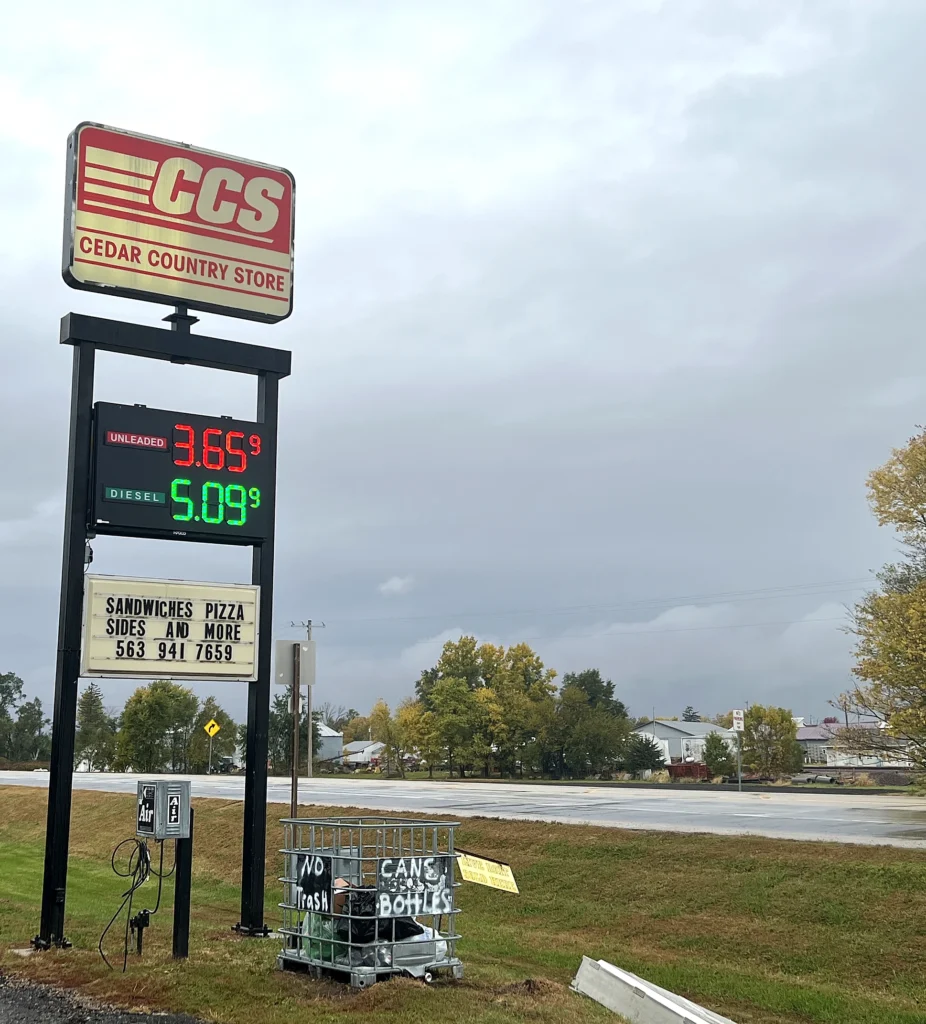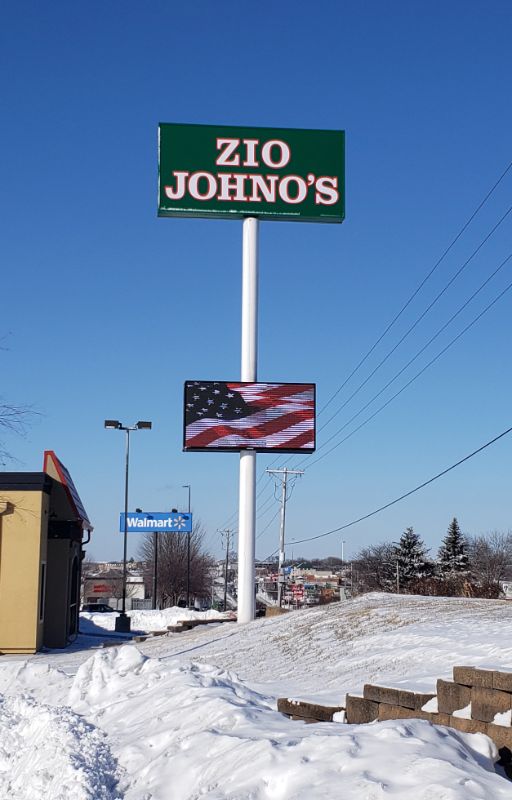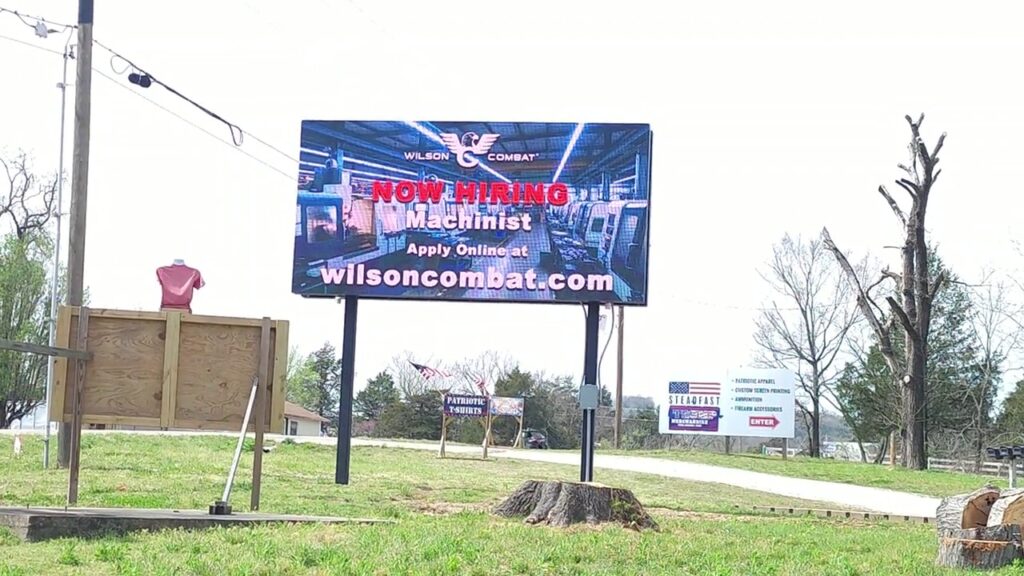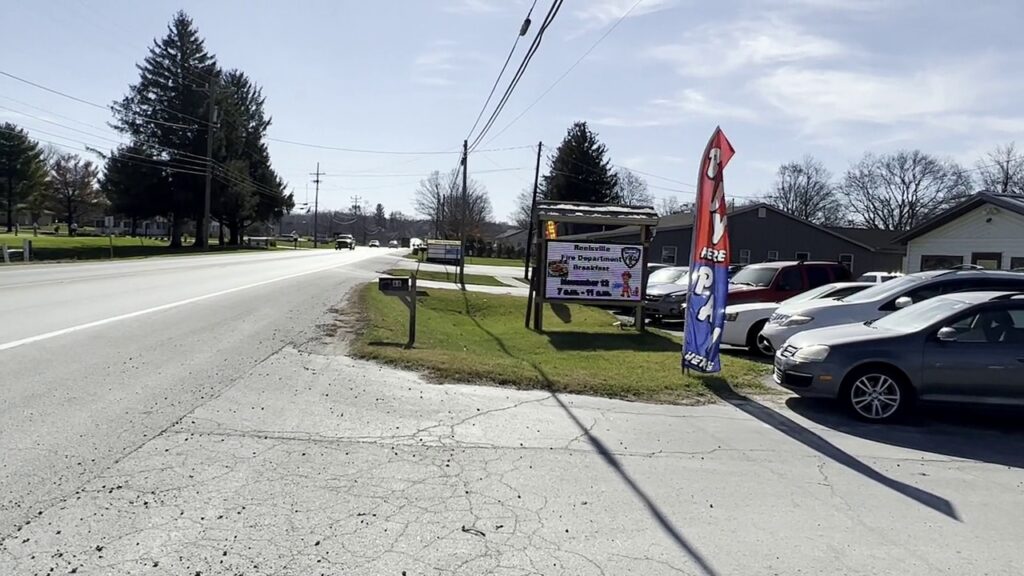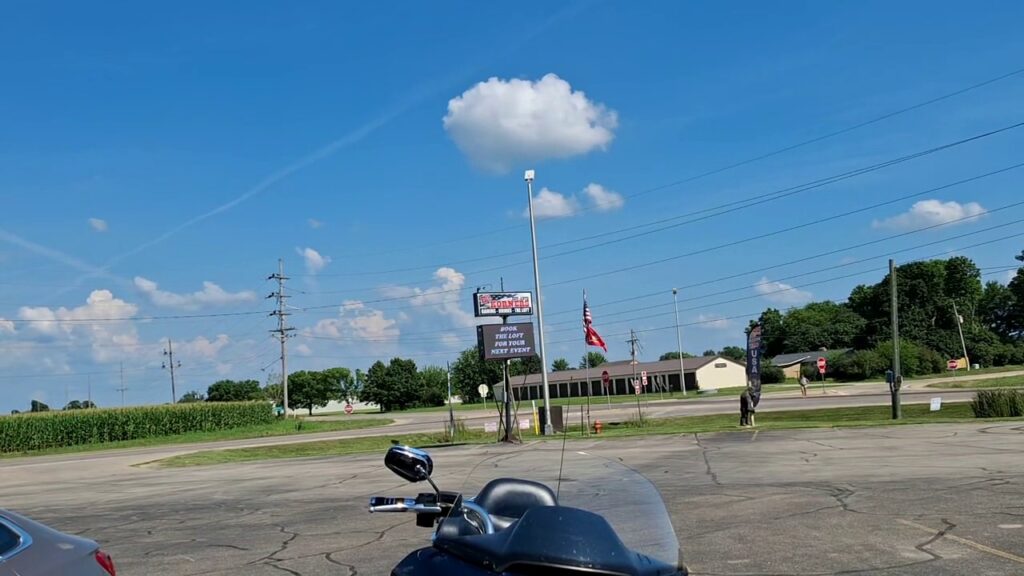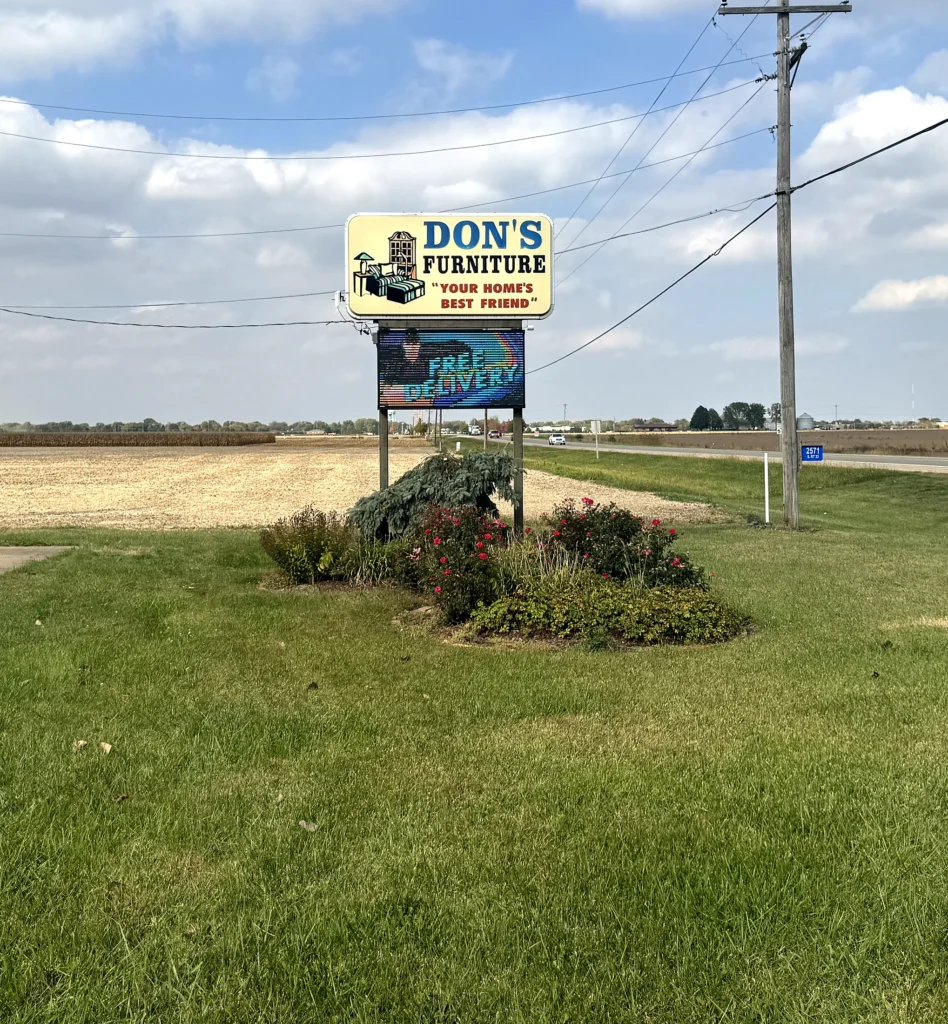
Is a digital billboard on your own property an on-premise sign or an off-premise billboard?
It depends on what it advertises, not how big it is. Under federal rules, a sign that names the business or its products on that property is an on-property sign. If it brings rental income to the property owner, it is treated as the business of outdoor advertising, which is regulated far more tightly near controlled highways.
FHWA's program overview puts it simply: signs are exempt from federal control if they solely advertise activities conducted on the property where they stand. States write their own tests, and federal rules suggest a property test (is the sign on the same property as the activity?) and a purpose test (is its sole purpose to identify that activity?).
Leasing a narrow strip of land by the highway just to place a sign does not make it on-premise. Federal rules tell states to curb exactly that, and Iowa's DOT, for example, warns that property bought or leased mainly to place a sign may make it a regulated advertising device.
| Question | On-premise roadside LED sign | Off-premise digital billboard |
|---|---|---|
| What it advertises | The business, products or events on that property | Other businesses, for rent |
| Federal Highway Beautification Act control | Exempt when it solely advertises on-site activity | Controlled near Interstate and federal-aid primary highways |
| Main permits | Local sign, building and electrical permits | State outdoor advertising permit plus local permits |
| Where it can go | Where local zoning allows signs | Only where state law allows, typically commercial or industrial areas |
| Message timing rules | Local code | State rules, often based on FHWA guidance, plus local code |
Sources: Federal Highway Administration - A History and Overview of the Federal Outdoor Advertising Control Program; 23 CFR 750.709, On-property or on-premise advertising, via Cornell Legal Information Institute; Iowa Department of Transportation - On-Premise Business Signs (one state's example)
What does the Highway Beautification Act control, and does your road count?
The Highway Beautification Act, signed October 22, 1965, makes states control outdoor advertising along Interstate and federal-aid primary highways. Inside urban areas the control reaches 660 feet from the right-of-way; outside them, to the limits of visibility. A state that fails to keep effective control faces a 10 percent cut in federal-aid highway funds.
The primary system for this purpose is the federal-aid primary system as it stood on June 1, 1991, plus roads on the National Highway System. FHWA notes that it often follows U.S. numbered highways, but not always, so ask your state DOT whether your frontage is on a controlled route.
Iowa is one state's example. Iowa DOT regulates outdoor advertising visible from the primary highway system, limits it to commercial and industrial areas, and prohibits it in the public right-of-way. Its rules exclude devices in incorporated areas more than 660 feet from the right-of-way, and signs a business installs for itself on its own property may be exempt.
Sources: Federal Highway Administration - A History and Overview of the Federal Outdoor Advertising Control Program; Iowa Department of Transportation - Advertising Signs (one state's example); Iowa Administrative Code 761, Chapter 117, Outdoor Advertising (IAC 6/24/26; one state's example)
Can you rent ad space on your own digital billboard?
Only where the law allows it. Selling space can turn an on-premise sign into a regulated billboard. Iowa DOT, as one state's example, restricts on-premise LED displays to messages about businesses and activities on the property, says running spot ads for others triggers regulatory review, and requires consultation to see whether the site qualifies for an outdoor advertising permit.
General messages such as time and temperature are acceptable on Iowa on-premise signs. Beyond that, a sign carrying outside ads must meet the state's billboard rules. In Iowa that means a site in an eligible commercial or industrial area, a permit with a $100 initial fee and an annual renewal for signs over 32 square feet, and LED ads that hold at least eight seconds. Your city may not allow off-premise signs at all.
Advertisers do pay for digital billboard time. Fit Small Business reports that a digital billboard can cost between $1,813 and $4,900 a month in cities like Davenport, Iowa. That is what advertisers pay on established boards, not a forecast for your sign; a smaller on-premise display on a slower road would draw a different market.
- Is the road a controlled Interstate or primary highway?
- Is the site zoned or used as commercial or industrial?
- Does your city allow off-premise signs?
- Who sells the space, schedules the ads and collects payment?
Sources: 23 CFR 750.709, On-property or on-premise advertising, via Cornell Legal Information Institute; Iowa Department of Transportation - On-Premise Business Signs (one state's example); Iowa Administrative Code 761, Chapter 117, Outdoor Advertising (IAC 6/24/26; one state's example); Fit Small Business - How Much Does Billboard Advertising Cost?
What do FHWA's digital billboard guidelines say about dwell time and brightness?
FHWA's 2007 guidance on off-premise digital billboards found that approved state rules generally hold each display 4 to 10 seconds, with 8 recommended, and keep transitions to 1 to 4 seconds, with 1 to 2 recommended. Brightness must adjust to light levels. States write the binding rules, and on-premise signs follow local code.
The memo also lists safeguards states found helpful: a default that freezes the display if it malfunctions, a way for the state DOT to order changes for safety, and static messages without animation, flashing, scrolling or video. It applies to conforming signs; putting new technology on a nonconforming billboard counts as a substantial change.
For night brightness numbers and auto-dimming, see the brightness section of the Digital & LED Signs guide.
| Rule | FHWA 2007 guidance (off-premise) | Iowa 761 IAC 117 (one state's example) |
|---|---|---|
| Message hold | Generally 4 to 10 s; 8 s recommended | At least 8 seconds |
| Transition | Generally 1 to 4 s; 1 to 2 s recommended | Within 1 second |
| Motion | Static messages; no animation, flashing, scrolling or video | Not flashed, rolled, scrolled or moved |
| Brightness | Adjust to changing light levels | Not set in the cited subrule |
Sources: Federal Highway Administration - Guidance on Off-Premise Changeable Message Signs (memorandum, Sept. 25, 2007); Iowa Administrative Code 761, Chapter 117, Outdoor Advertising (IAC 6/24/26; one state's example)
How big should a roadside LED sign be for highway speeds?
Size from letter height. USSC rules of thumb give drivers 11 to 12 seconds to notice, read and react on high-speed multi-lane roads. At a legibility index of 30, that works out to capital letters of about 30 to 32 inches at 55 mph and about 35 to 38 inches at 65 mph.
For scale, FHWA lists standard billboard faces: a poster panel is 12 by 25 feet (300 square feet) and a painted bulletin is 14 by 48 feet (672 square feet). Local codes often cap on-premise sign area well below that, so check yours before you fall in love with a size. Pixel pitch and resolution are covered in the Digital & LED Signs guide.
Turn the face toward traffic. In USSC research, drivers almost never missed perpendicular signs but drove past 30 percent of parallel signs.
| Road and speed | USSC reaction time | Distance covered | Capital letter height |
|---|---|---|---|
| 45 mph, four to five lanes | 10 seconds | About 662 ft | About 22 in |
| 55 mph, multi-lane | 11 to 12 seconds | About 889 to 970 ft | About 30 to 32 in |
| 65 mph, multi-lane | 11 to 12 seconds | About 1,051 to 1,147 ft | About 35 to 38 in |
| 70 mph, multi-lane | 11 to 12 seconds | About 1,132 to 1,235 ft | About 38 to 41 in |
Sources: Federal Highway Administration - A History and Overview of the Federal Outdoor Advertising Control Program; United States Sign Council - Sign Legibility Rules of Thumb (2006)
What structure and engineering does a large roadside LED display need?
A steel structure on a concrete footing sized for local wind, which the International Building Code sets through ASCE 7. HomeGuide notes that codes require stamped structural drawings in some cases, typically including pylons, and that engineers charge $500 to $3,000 for sign plans. Ask how the footing was sized for your county's design wind.
A large display is a sail. Wind pressure on the face drives the pole size, the footing and often the crane needed to set it. Keep the whole structure on your property: Iowa DOT, for example, prohibits outdoor advertising signs in the public right-of-way, and it advises checking property lines so a sign is not placed in the right-of-way of a primary highway.
Power is the other site cost. HomeGuide puts underground power runs at $10 to $25 per foot installed, so a sign at the far edge of a large lot can add real money before the display lights up.
Sources: Iowa Department of Transportation - Advertising Signs (one state's example); International Code Council - Demystifying Loads: 2024 IBC and ASCE 7-22 (IBC Section 1609.1.1); HomeGuide - How Much Does a Business Sign Cost? (Dec. 19, 2023)
What does a digital billboard cost to build and run?
National consumer guides do not publish one range for a full-size digital billboard. The closest figures: HomeAdvisor says a tall billboard visible from a long distance can cost as much as $200,000, and HomeGuide cites up to $200,000 for a lighted, double-sided highway pylon. These are third-party estimates, not Suntronix pricing.
Running costs continue after installation: electricity, any cellular or software subscription, content creation, maintenance, and permit renewals if the sign carries outside ads. Ask for the display's average and maximum power draw and multiply by your hours and electric rate. Suntronix provides maintenance and repair support for products it sells, with scope set by the project terms, and financing may be available for qualifying projects.
| Item | Published range | Source |
|---|---|---|
| Tall billboard visible from a long distance | Up to $200,000 | HomeAdvisor |
| Lighted double-sided pylon visible from the highway | Up to $200,000 | HomeGuide |
| Pylon and pole signs, most sizes | $20,000 to $100,000 | HomeAdvisor |
| Structural engineering plans | $500 to $3,000 | HomeGuide |
| Underground power run | $10 to $25 per foot | HomeGuide |
| Building permit | $400 to $2,500 | HomeAdvisor |
| Iowa outdoor advertising permit, if selling ads (one state's example) | $100 initial fee plus annual renewal | Iowa 761 IAC 117 |
Sources: Iowa Administrative Code 761, Chapter 117, Outdoor Advertising (IAC 6/24/26; one state's example); HomeGuide - How Much Does a Business Sign Cost? (Dec. 19, 2023); HomeAdvisor - How Much Does Commercial Sign Installation Cost? (updated June 20, 2026)
What should you have ready before asking for a roadside LED sign quote?
The address and highway route number, photos of each approach from where drivers first see the site, the speed limit, the distance from the pavement to your property line, zoning, power location, and whether you ever plan to sell ad space. That last answer decides which rules apply, so settle it first.
A Suntronix representative reviews the site, and Suntronix provides the drawings and specifications a permit application needs. Permitting and installation can be coordinated for a fee, matched to an installer network, or handed to your own local installer. On-site surveys and installation coordination are available in the Quad Cities and the surrounding three-hour market.
- Highway name and number, and whether the state lists it as a primary route.
- Photos of both approaches, taken safely by a passenger.
- Survey or plat showing property and right-of-way lines.
- Planned content, including any outside advertising.
- Logo files; the quote form takes JPG, PNG or PDF up to 5 MB.