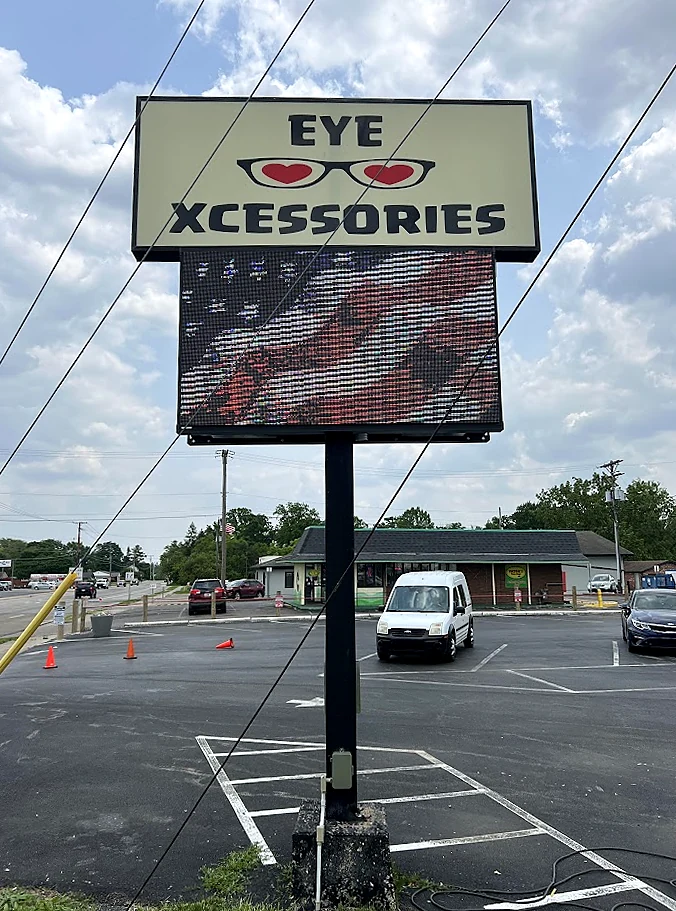
How much time does a highway traveler have to read a hotel sign?
Very little. At 60 mph a car covers 88 feet per second, and USSC estimates 11 to 12 seconds to notice, read and maneuver in high-speed multilane traffic. That means a hotel sign has to be read from roughly 1,000 feet away, with letters sized for that distance.
USSC sizes letters by dividing the reading distance by a legibility index, with 30 as a common rule of thumb. At 88 feet per second for 12 seconds, a driver needs to read the sign at about 1,056 feet, which works out to capital letters near 35 inches tall. The name gets that space, not the slogan.
Interstate travelers often decide before the exit, so the sign should also read from the ramp and the crossroad. For structure and wind design, see the Pylon Signs page.
Sources: United States Sign Council - Sign Legibility Rules of Thumb (2006)
How high should a hotel sign stand near an interstate?
High enough to clear traffic and terrain, not so high it leaves the driver's field of view. USSC guidance uses a five-degree viewing angle above the driver's eye: at 400 feet of detection distance, that limits sign height to about 38.5 feet. Local height caps often set the real limit.
The USSC formula is sign height equals detection distance times 0.088, plus 3.5 feet. A sign meant to be picked up 600 feet out could stand about 56 feet tall by that measure, but many local codes cap freestanding signs well below that. Check the cap before you design.
A Suntronix representative reviews the site before a custom sign is designed. National guides put pylon signs at $10,000 to $100,000 or more installed and outdoor LED signs at $750 to $30,000; these are third-party estimates, not Suntronix pricing.
Sources: USSC Foundation - On-Premise Signs Guideline Standards (2018); HomeGuide - How Much Does a Business Sign Cost? (Dec. 19, 2023); HomeAdvisor - How Much Does Commercial Sign Installation Cost? (updated June 20, 2026)
Can motel signs show room rates?
Often, but some states regulate how. Wisconsin, for example, bars outdoor rate signs unless they show both the minimum and maximum room rates at the same size, and rooms must be available at the posted rates when vacant. Check your state's lodging or consumer protection law before putting a rate on any sign.
Wisconsin defines an outdoor sign as any sign visible to passersby, whether it is located inside or outside the building. By that definition, a rate in a lobby window counts, and so would a rate on a message center. A per-person rate or an "and up" price does not comply there.
If you post vacancy, keep it current. A message center can switch from VACANCY to NO VACANCY without a trip outside to change a panel.
Sources: Wisconsin State Legislature - Wis. Stat. 97.639, Motel rates (one state's example)
How do interstate LODGING logo signs work?
They are the Specific Service signs before an exit that show business logos under headings like LODGING. The federal MUTCD sets the framework, and each state that offers them runs its own program, eligibility rules and fees. Your own sign then has to take over at the ramp so the driver who exits can find you.
Under the 11th edition MUTCD, a lodging business should have licensing where required, adequate sleeping accommodations and modern sanitary facilities. Eligible services should generally be within 3 miles, extendable in 3-mile steps up to 15 miles if no closer business participates. One sign carries no more than six business panels.
States set the costs to businesses for permits, installation, annual maintenance and removal of the panels. Where a hotel is not readily visible from the ramp terminal, the MUTCD calls for ramp signs pointing the way; your on-premise pylon confirms the turn.
Flagged hotel or independent motel: what changes on the sign?
A flagged hotel follows its brand's sign standards, which usually fix the logo, colors and cabinet design. An independent motel designs its own sign, so the sign has to answer the traveler's questions itself: name, price range, vacancy and the amenity worth exiting for. STR found 61 percent of U.S. hotels are small businesses.
For a flagged property, get the brand standards manual and approved supplier rules before asking for quotes, and ask whether a local message center is allowed below the brand cabinet. For an independent, one strong name and one changeable line usually beat a crowded cabinet.
Sources: American Hotel & Lodging Association - U.S. Hotel Small Business Ownership Study (Feb. 10, 2021)
What should hotel signs show on an LED message center?
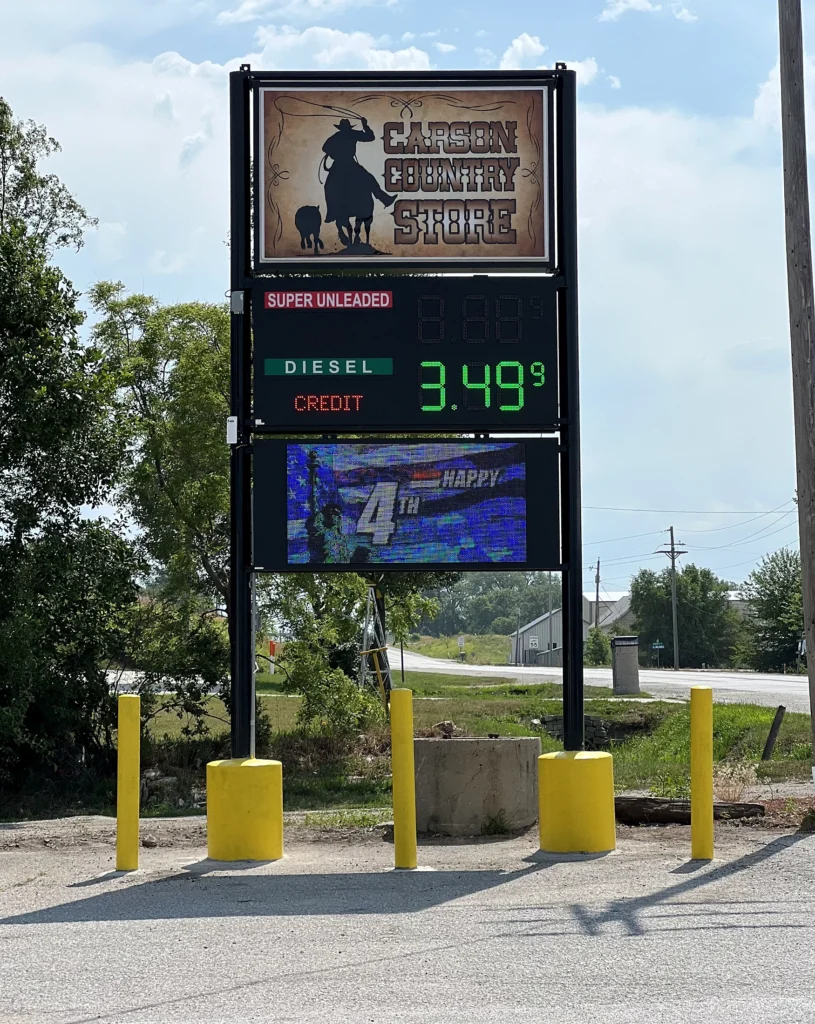
Rates where the law allows, vacancy, and the amenities that decide a late-night stop, such as a pool, breakfast or pet-friendly rooms. Keep each frame to one idea a driver can read in a few seconds. At 88 feet per second, a long scrolling list is gone before it is read.
Local hold-time rules limit how many frames a passing driver sees. Clemson, South Carolina, for example, requires each message on its multi-business signs to stay fixed for at least 15 seconds. Put the most important frame first.
Suntronix builds full-color LED message centers and includes on-site training for the software, communication setup and scheduling with every digital sign order, so front-desk staff learn the schedule on their own display.
Sources: United States Sign Council - Sign Legibility Rules of Thumb (2006); City of Clemson, SC - Code of Ordinances, sign standards (online page 505; one city's example)
How bright should a hotel sign be through the night?
Bright enough for the highway, dim enough for guests and neighbors. USSC recommends a maximum nighttime brightness of 700 nits for all types of signs, and ISA research recommends that message centers stay within 0.3 footcandles over ambient light. Automatic dimming keeps an all-night sign inside those limits.
USSC notes that message centers must be dimmed to 2 to 8 percent of daytime brightness at night, and a photocell lets the display dim as light changes. Remember your own guests: rooms facing the sign see it all night, so set night brightness at the low end that still reads.
Sources: USSC Foundation - On-Premise Sign Standards: Sign Lighting (Feb. 2018); International Sign Association - EMC Brightness Level Recommendations; International Sign Association - Night-time Brightness Level Recommendations for On-Premise Electronic Message Centers (updated August 2016)