What must a gas station sign show by law?
In many states, the full price. California requires a sign visible from the street showing the total price per gallon of the three major grades, including all taxes, in numerals at least six inches tall. Maryland requires numerals at least 8 inches high. Rules differ by state, so check with your state weights and measures office first.
California also requires the fuel brand on the price sign at no less than one-third the size of the price numerals, and a station on an intersection must be visible from each street. Maryland exempts signs required by state or federal law at a service station from local limits on the number and area of signs.
Legal minimums are not the same as legible. USSC rules of thumb put legibility at about 30 feet per inch of capital letter height, so six-inch numerals read at roughly 180 feet and eight-inch numerals at roughly 240 feet. Florida goes further and bars local rules that keep a gas price sign from being clearly visible and legible to approaching drivers from any lane.
| State | What the sign must show | Numeral size |
|---|---|---|
| California (Bus. and Prof. Code 13531-13532) | Total price per gallon including all taxes for the three major grades; brand at one-third numeral size | At least 6 inches tall |
| Maryland (Bus. Reg. 10-315, amended 2024) | Total of price and all taxes; credit and debit price of regular if higher than cash, or both | At least 8 inches high and 3.5 inches wide |
Sources: California Business and Professions Code Section 13531 (statute text via California Public Law); California Business and Professions Code Section 13532 (statute text via California Public Law, updated Jan. 1, 2017); Maryland General Assembly - 2024 Laws of Maryland, Chapter 451 (House Bill 882), Business Regulation Section 10-315; United States Sign Council - Sign Legibility Rules of Thumb (2006); The Florida Legislature - 2026 Florida Statutes, Section 553.79
How should cash and credit prices appear on a fuel sign?
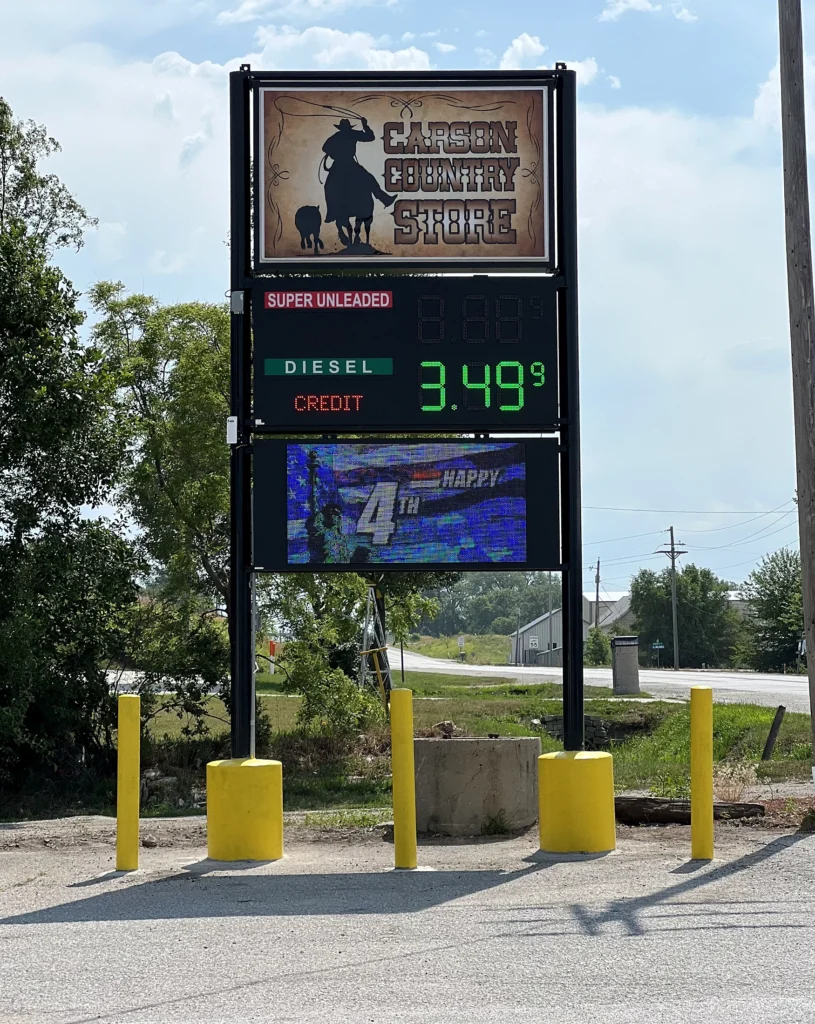
Show every price a customer might pay, at the same size. Maryland requires the sign to show the credit and debit price of regular gasoline when it is higher than cash, or both prices. California requires each higher price for the same grade in numerals of equal size, with the conditions explained. Count price lines before ordering.
Price is why drivers pick a station. In a 2025 NACS survey, 72 percent of drivers named price as the most important factor, and 69 percent said they would drive five minutes out of their way to save five cents a gallon. A sign that advertises a cash price a card customer will not get can break these rules.
List every line you need: regular, mid-grade, premium and diesel, each with cash and credit if you price them differently. California also requires the words explaining different prices in letters at least one-third the size of the price numerals.
Sources: California Business and Professions Code Section 13532 (statute text via California Public Law, updated Jan. 1, 2017); Maryland General Assembly - 2024 Laws of Maryland, Chapter 451 (House Bill 882), Business Regulation Section 10-315; NACS - Key Facts About Fueling; NACS - What Happens to Gas Prices When Oil Prices Rise?
LED price displays or manual price numbers?
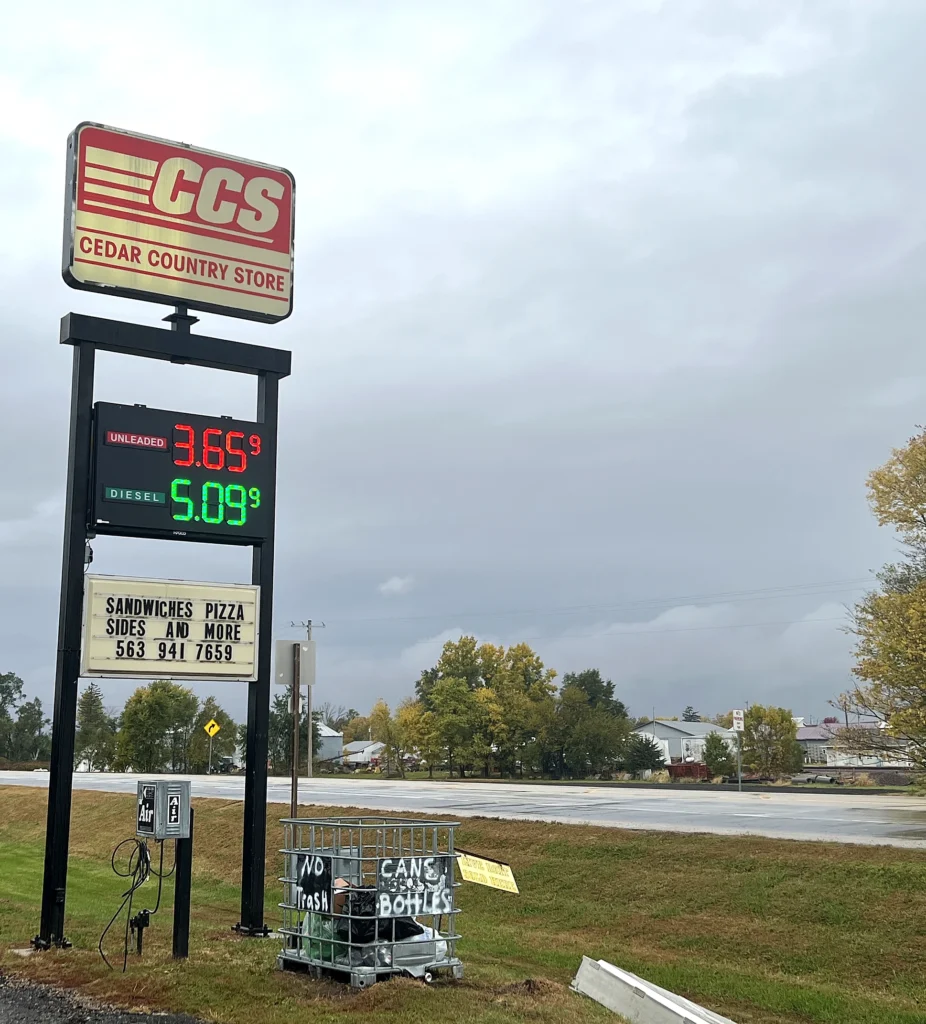
LED price displays are changed from a controller, so prices can follow the market without anyone climbing a ladder in bad weather. Manual numbers cost less up front but take labor at every change. Check the code first: some cities treat electronic fuel price displays differently from other digital signs.
Woodland Park, Colorado lets a fuel pricing sign be electronic, but the display may change only when the price changes and may not exceed 1,000 nits between dusk and dawn. Belmont, California allows changeable copy on fuel price signs up to 25 percent of the establishment's maximum sign area.
Either way, the numerals must still meet your state's size and tax rules. National guides put outdoor LED and digital signs at $750 to $30,000, a third-party estimate rather than Suntronix pricing.
Sources: City of Woodland Park, CO - Permanent Sign Brochure, fuel pricing signs (one city's example); City of Belmont, CA - Zoning Ordinance 23.5.2, Changeable Copy (one city's example); HomeAdvisor - How Much Does Commercial Sign Installation Cost? (updated June 20, 2026)
What do branded fuel agreements control on the sign?
Usually the brand elements: canopy fascia, pump graphics and the fuel brand on the price sign. A branded retailer sells fuel under a major oil company or refiner's name but is usually not owned by that company. Read your supply agreement and the brand's image standards before designing anything that carries the fuel brand.
NACS reports that around 55 percent of fuel-selling stores are single-store operators, and many cannot brand their stores separately from the fuel brand on the canopy. The result is a common misconception that a major oil company owns the store. If you want your own name to build loyalty, give it its own sign on the building, pylon or monument.
Unbranded stations have more freedom, within state price sign rules. In Florida, state law also limits local aesthetic requirements that conflict with fuel brand trademarks, logos, color patterns and image standards.
Sources: The Florida Legislature - 2026 Florida Statutes, Section 553.79; NACS - Key Facts About Fueling; NACS - Convenience Stores Sell the Most Gas (June 19, 2026)
Which signs go on the canopy, the pumps and the road?
The roadside pylon or monument does the finding: name, price and offer, facing traffic. The canopy confirms the brand as drivers turn in, and pump-top signs sell at the island. Canopy fascia runs parallel to the road, and in a USSC study drivers passed 30 percent of parallel signs even while looking for them.
USSC drops the legibility index for parallel signs to 10, against 30 for signs facing traffic, so a canopy letter must be about three times taller to read at the same distance. Put the price on the sign that faces the road.
Codes often set rules for each piece. Clemson, South Carolina lets fuel stations attach one sign on or just above each pump, up to 1.5 square feet. Woodland Park allows fuel price signs on the building, the canopy or a freestanding sign's support, at least eight feet above the ground.
Sources: United States Sign Council - Sign Legibility Rules of Thumb (2006); City of Woodland Park, CO - Permanent Sign Brochure, fuel pricing signs (one city's example); City of Clemson, SC - Code of Ordinances, sign standards (online page 505; one city's example)
What should a convenience store sign put on its message center?
Sell what is inside: coffee, food deals, the car wash, hiring and hours. Run one offer per frame, written to read at road speed, and leave fuel prices on their own price display. Check local hold-time rules, because they decide how many frames a passing driver can see.
Hold times vary widely. Clemson, South Carolina requires each message on its multi-business signs to stay fixed for at least 15 seconds; at that pace most drivers see one frame, so every frame must stand alone. Schedule morning, midday and evening offers ahead of time.
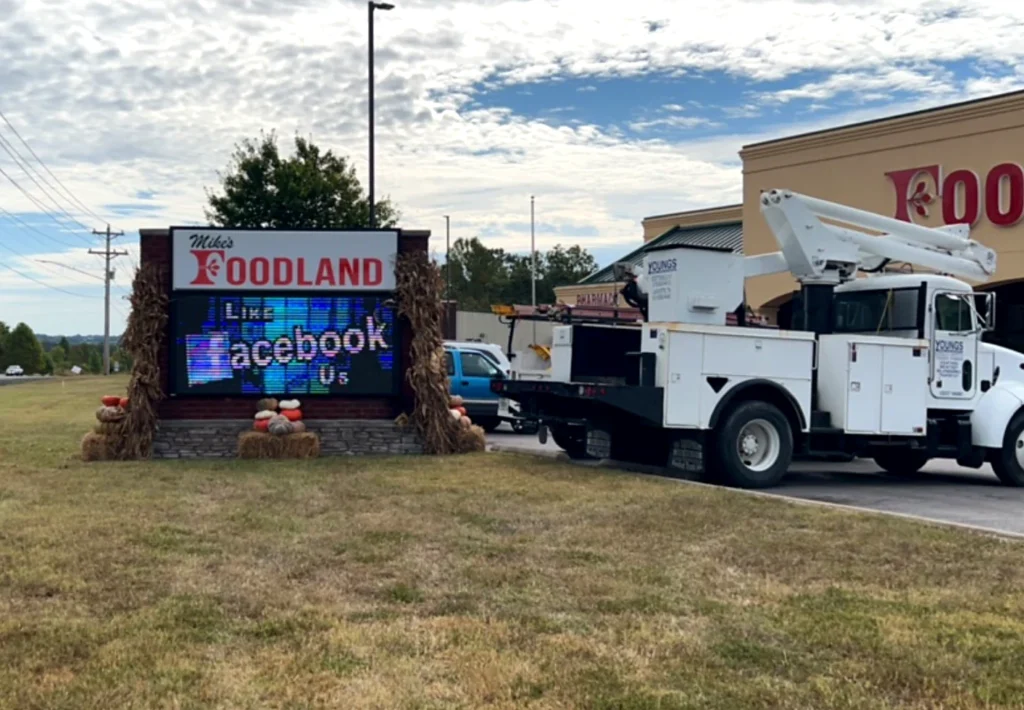
Suntronix builds full-color LED message centers and includes on-site training for the software, communication setup and scheduling with every digital sign order. For resolution and viewing distance, see the pixel pitch guide on the Digital & LED Signs page.
Sources: City of Clemson, SC - Code of Ordinances, sign standards (online page 505; one city's example)
How bright should a 24-hour station's signs be at night?
Bright enough to read, not bright enough to glare. ISA research recommends message centers stay within 0.3 footcandles over ambient light, and USSC recommends a maximum nighttime brightness of 700 nits for all types of signs. Automatic dimming handles the change from day to night without anyone touching the controls.
USSC notes that message centers must be dimmed to 2 to 8 percent of daytime brightness at night, and a photocell lets a display dim as light changes. Local codes may set their own cap, such as the 1,000-nit nighttime limit on fuel price displays in Woodland Park.
Stations open all night often sit next to homes, so aim lighted cabinets at the property, not the neighbors.
Sources: City of Woodland Park, CO - Permanent Sign Brochure, fuel pricing signs (one city's example); International Sign Association - EMC Brightness Level Recommendations; USSC Foundation - On-Premise Sign Standards: Sign Lighting (Feb. 2018); International Sign Association - Night-time Brightness Level Recommendations for On-Premise Electronic Message Centers (updated August 2016)