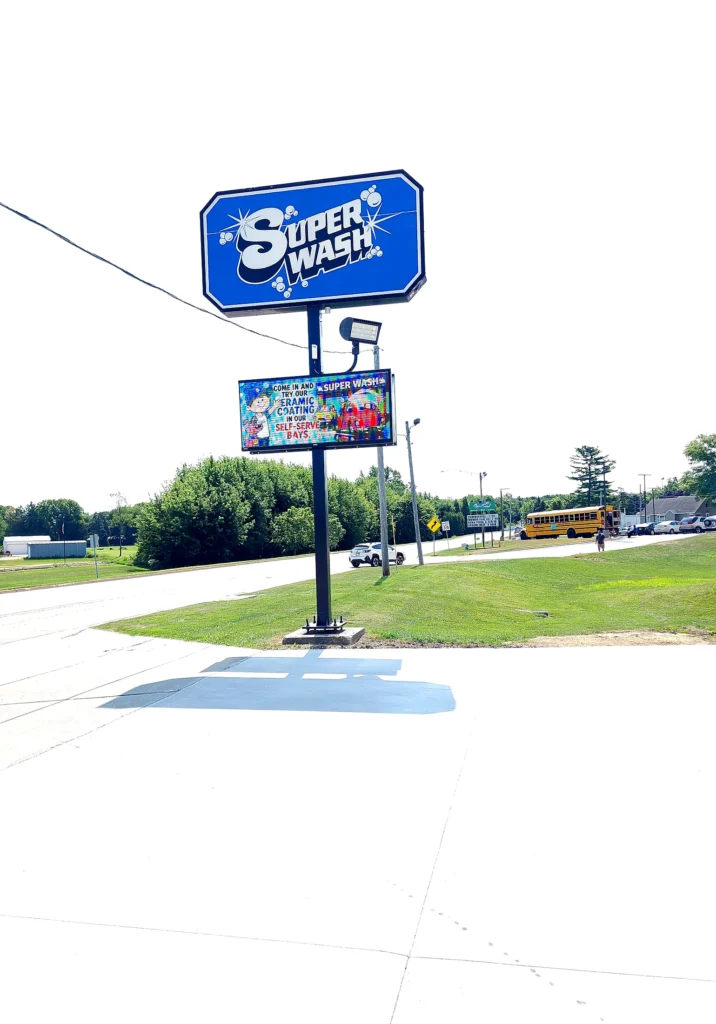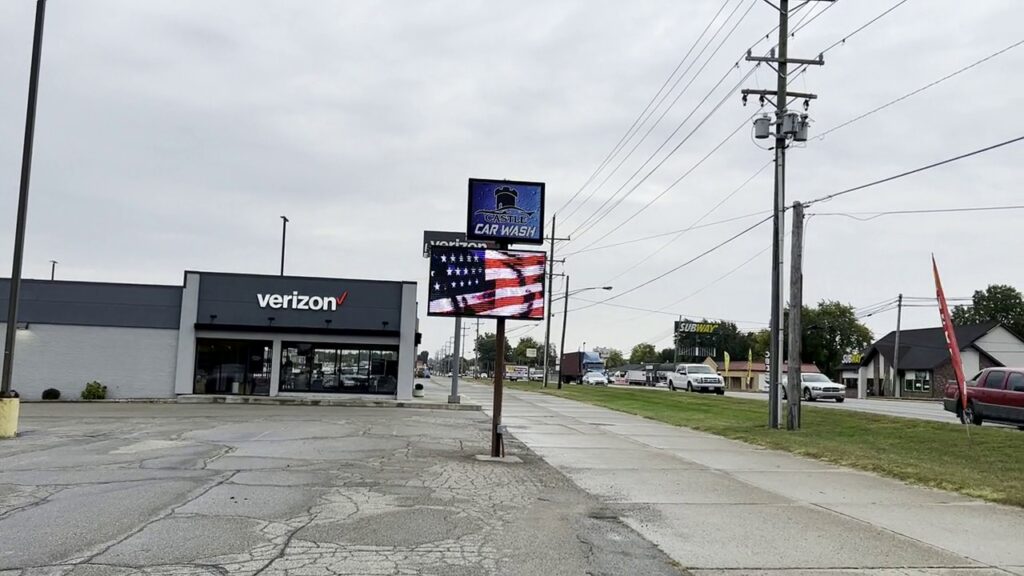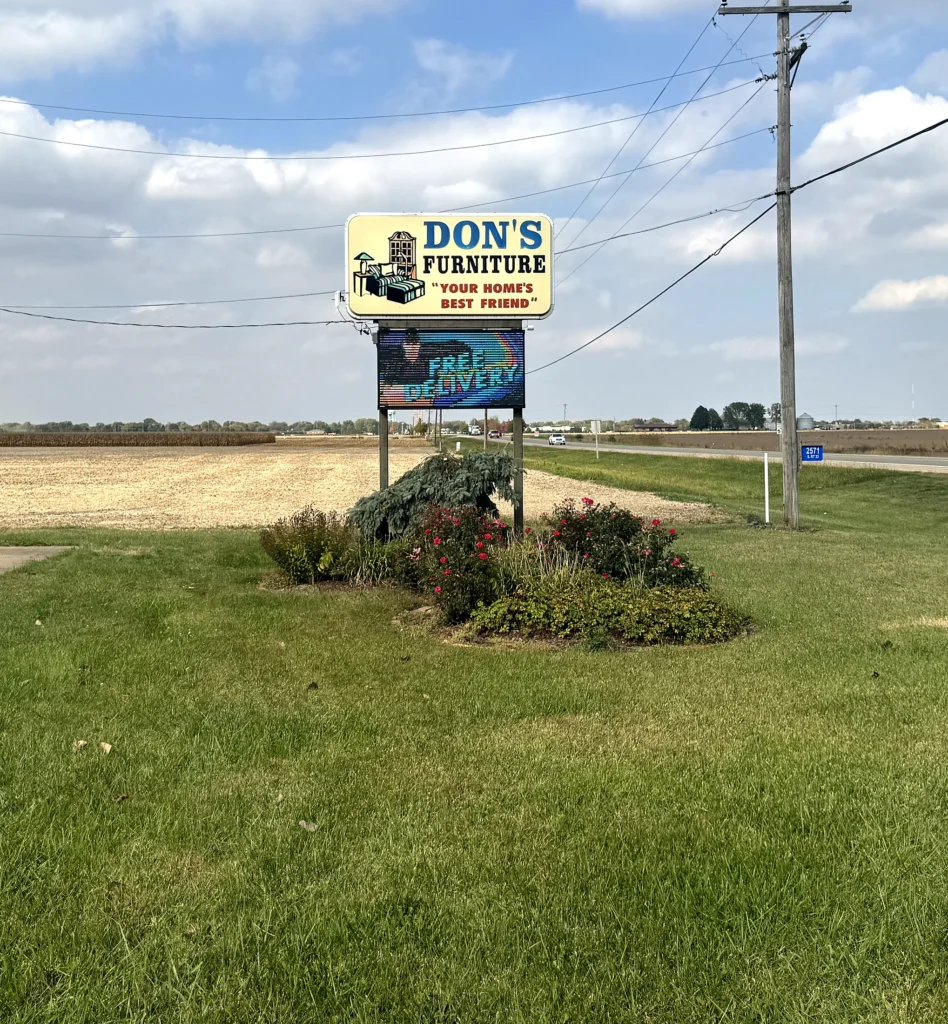
What do car wash signs need to do from the road?
Most washes are bought on the way past, so the roadside sign has to make the decision easy: the word Wash or the brand, one price or club offer, and a clear entrance. On a 45 mph road a driver has about 10 seconds to notice, read and turn, so short copy and large letters win.
The habit is there to tap. The International Carwash Association reports that the share of U.S. drivers who most often wash at a professional car wash rose from about 48 percent in 1994 to nearly 80 percent today. Your sign is competing for a decision drivers already make; it decides which wash gets it.
Weather sets the mood. A 2025 industry report based on data from more than 7,400 wash sites found that clear skies boost retail demand, while heavy cloud cover or strong wind reduces impulse wash purchases. That is the case for a sign that can change its message, covered below.
USSC rules of thumb give a driver about 10 seconds on a four- to five-lane road over 35 mph and use roughly 30 feet of reading distance per inch of capital letter. At 45 mph that works out to capital letters of about 22 inches, a calculation rather than a code rule.
Sources: International Carwash Association - Carwash Industry Information; Professional Carwashing & Detailing - AMP Q3 report reveals carwash weather insights (Oct. 29, 2025); United States Sign Council - Sign Legibility Rules of Thumb (2006)
How do sign needs differ for express, full-service and self-serve washes?
Express tunnels need strong roadside identity, lane and pay-station menus and club promotion. Full-service washes add detail menus and customer areas. In-bay automatics often share a site with fuel, so the wash competes with fuel prices on one sign. Self-serve bays need lit bay numbers, prices and instructions that work around the clock.
Each format is a big share of the market. An ICA-commissioned 2020 study estimated about 17,500 conveyor washes, 29,000 in-bay automatics and 16,250 self-service washes in the United States, and noted the last two often have no employees or are part of a gas station or convenience store. A sign at an unstaffed wash has to answer every question a cashier would.
Most operators are small. Census data for 2019 counted 16,976 car washes with paid employees, and 9,048 of them had fewer than five employees. Whoever runs the sign is usually also running the wash, so the message plan has to be simple.
| Wash type | Roadside | On site |
|---|---|---|
| Express exterior tunnel | Brand, club price, message center | Lane entry, menu at pay station, club sign-up, exit and vacuum directions |
| Full-service | Brand, services, hours | Service and detail menu, customer entrance, pickup area |
| In-bay automatic | Shared with fuel or store sign | Wash menu at entry, bay entrance, height and instructions |
| Self-serve bays | Brand, open 24 hours if true | Lit bay numbers, cycle prices, payment instructions |
Sources: International Carwash Association - Carwash Industry Information; U.S. Census Bureau - Car Washes Help Maintain What May Be the Second-Largest Investment Many Will Make (June 2021)
How should car wash signs promote a wash club?
Put the club price where the decision happens: one frame on the roadside message center, the club option beside single washes on the menu board, and a short join reminder at the exit. Members keep washing in bad weather, so every sign along the lane should make the monthly plan easy to understand.
Memberships steady the business. In the 2025 industry data, rainfall cut retail wash volume by more than 50 percent while unlimited plan volume declined far less. The ICA notes that the popularity of subscription plans has drawn substantial new investment into the industry, which also means more competing clubs nearby.
Keep club copy simple: the monthly price, what it includes and how to join. Terms and fine print belong at the pay station or on the website, not on a sign read from a moving car.
Sources: International Carwash Association - Carwash Industry Information; Professional Carwashing & Detailing - AMP Q3 report reveals carwash weather insights (Oct. 29, 2025)
How can an LED message center react to the weather?
Build weather frames in advance and switch them as conditions change: a clean-car message on clear days, a club offer during rain, an after-the-storm message when skies clear, and a salt and underbody message in winter. One message per frame, within the hold time your code allows.
Timing matters. The same industry report found that when rain passes early, wash volume rebounds within four to six hours and can exceed normal levels later that day. A message center already loaded with an after-rain frame is ready for that rebound. Snowfall also showed lower churn and higher premium plan adoption.
Winter salt is a reason to wash, not just a mess. A Connecticut trade report noted that when the temperature dips below 25 degrees the state uses magnesium chloride, which combined with salt can corrode vehicles. Underbody and salt-removal offers fit those weeks.
Hold times limit how many frames a driver sees. Panguitch, Utah allows a change no more than once every 8 seconds, and Clemson, South Carolina requires 15 seconds on multi-business signs; each is one city's example. The USSC model code, by contrast, permits most display features in commercial zones except flashing. Suntronix includes on-site training for the software, communication setup and scheduling with every digital sign order.
- Clear day: brand plus best single-wash price.
- Rain: club offer, such as wash all month for one price.
- Rain clearing: open now, short line, after-rain special.
- Winter: salt removal and underbody wash.
- Always: hours, hiring, club sign-up reminder.
Sources: Professional Carwashing & Detailing - AMP Q3 report reveals carwash weather insights (Oct. 29, 2025); Professional Carwashing & Detailing - The good and bad of winter weather for carwashes (Feb. 24, 2014; New London, Conn.); USSC Foundation - Model On-Premise Sign Code (a model, not law); City of Clemson, SC - Code of Ordinances, sign standards (online page 505; one city's example); Panguitch City, UT - Signage Permit and sign requirements (one city's example)
What signs do the entrance, menu, lanes and exit need?
Plan the lot as a sequence: an entrance sign that is visible before the turn, lane and stacking signs, a menu board at the pay point, vehicle restrictions before the tunnel or bay, and exit and vacuum directions. Many codes treat small directional signs and drive-lane menu boards separately from your main sign allowance.
Small direction signs are often exempt. The USSC Foundation's model sign code, a model rather than law, allows directional signs in all zones without counting them toward total sign area, with freestanding directional signs up to 6 square feet and 96 inches tall. Your own code sets the actual limits.
Menu boards are handled case by case. Greenville, Pennsylvania, as one town's example, caps menu board signs at 50 square feet, requires them next to a drive-through lane and behind the principal structure, and leaves them out of the maximum sign area. Ask whether your city treats a pay lane as a drive-through lane.
Signs above drive lanes need clearance. The National Electrical Code requires an electric sign to be at least 14 feet above areas accessible to vehicles unless it is protected from physical damage.
Sources: USSC Foundation - Model On-Premise Sign Code (a model, not law); Greenville, PA - Code Chapter 436, Signs and Billboards, Section 436-81 Menu board signs (one town's example); EC&M - NEC Rules for Electric Signs and Outline Lighting (NEC Article 600)
How do you protect car wash signs from spray, chemicals and salt?
Keep electronics and cabinets out of the spray and mist zone where you can, specify weatherproof construction with drain holes for anything near the bays, and use impact-resistant faces where vehicles and hoses are close. Plan service access, because signs near a wash get dirtier and corrode faster than a roadside sign.
The electrical code already expects water. Under NEC Article 600, signs installed in wet locations must be weatherproof and have drain holes, and required markings must be weatherproof too. Mist from blowers and wands, plus winter salt carried in on cars, makes the area around the tunnel exit and the self-serve bays harder on signs than the street.
Faces near traffic take knocks from mirrors, hoses and brushes. GE describes its Lexan SG305 sign sheet as combining high impact resistance with optical clarity. Suntronix offers a limited warranty on qualifying Lexan lighted sign faces; vandalism is excluded, and coverage is confirmed in the proposal.
Sources: EC&M - NEC Rules for Electric Signs and Outline Lighting (NEC Article 600); GE Structured Products - Lexan SG305 Sheet for Signs, product data sheet
How bright can a car wash LED sign be, and how should 24-hour bays be lit?
Many codes cap message center brightness at 0.3 footcandles above ambient light and require automatic dimming. That still leaves the sign easy to read at night. For 24-hour self-serve washes, light the roadside sign, bay numbers and price signs so a driver can see the wash is open and how to pay.
The International Sign Association recommends message centers not exceed 0.3 footcandles over ambient light, and the USSC Foundation sets 700 nits as the outer limit for night brightness. Clemson, South Carolina also keeps the leading edge of a message board at least 100 feet from residential property, one city's example of a neighbor rule.
A dark self-serve wash looks closed. Lit bay identifiers, cycle prices and payment instructions tell a night customer the wash is running and remove the hesitation at the bay entrance.
Sources: International Sign Association - EMC Brightness Level Recommendations; USSC Foundation - On-Premise Sign Standards: Sign Lighting (Feb. 2018); City of Clemson, SC - Code of Ordinances, sign standards (online page 505; one city's example)
What do car wash signs cost?
National guides put outdoor LED and digital signs at $750 to $30,000, pylon signs at $10,000 to $100,000 or more installed, monument signs at $5,000 to $20,000 or more, and outdoor lighted signs at $500 to $5,000. These are third-party estimates, not Suntronix pricing; each project is priced around the site.
A changeable-letter marquee or reader board costs less to own but needs someone on a ladder for every price change, which is hard to keep up with when offers follow the weather. Financing may be available for qualifying projects.
| Sign type | Estimated range | Source |
|---|---|---|
| Outdoor lighted sign | $500 to $5,000 | HomeAdvisor |
| Outdoor LED and digital sign | $750 to $30,000 | HomeAdvisor |
| Monument sign | $5,000 to $20,000+ installed | HomeGuide |
| Pylon sign | $10,000 to $100,000+ installed | HomeGuide |
Sources: HomeAdvisor - How Much Does Commercial Sign Installation Cost? (updated June 20, 2026); HomeGuide - How Much Does a Business Sign Cost? (Dec. 19, 2023)