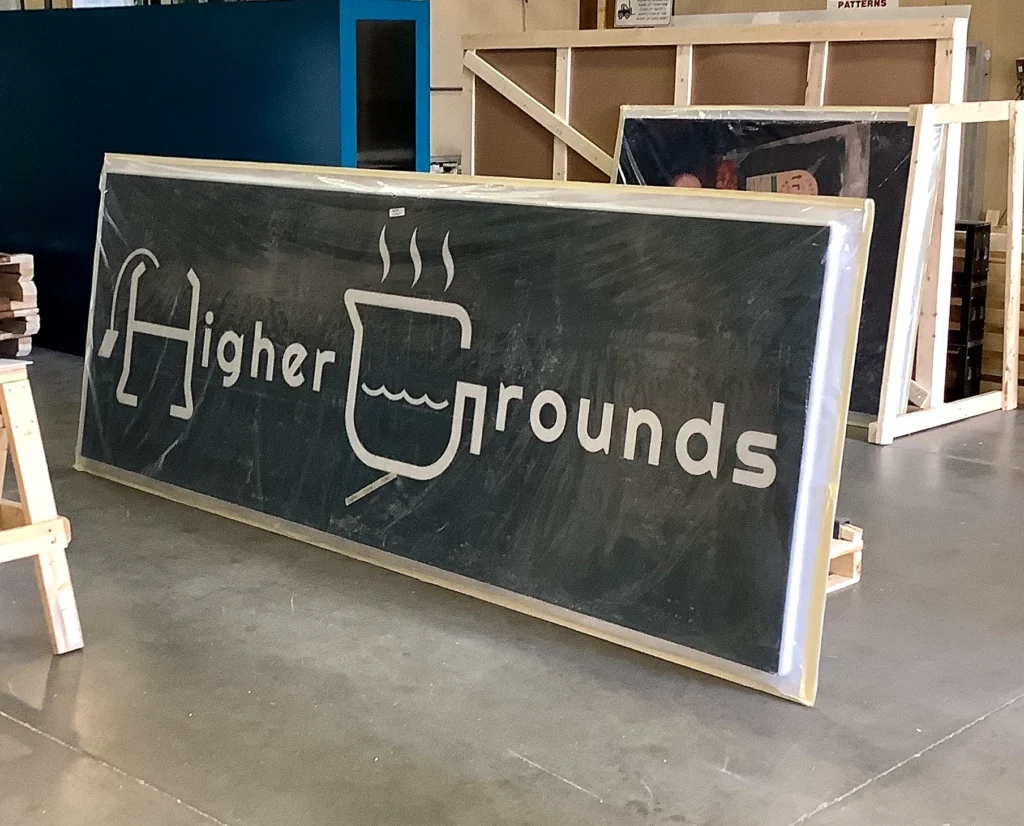
What is a cabinet sign, and what styles are there?
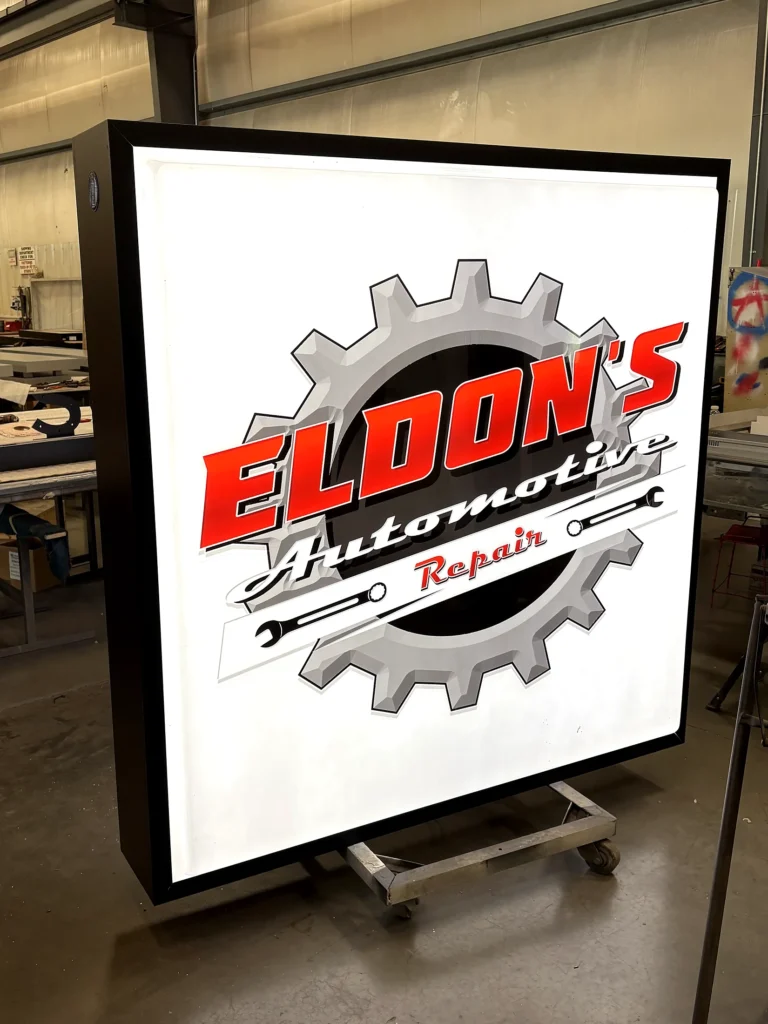
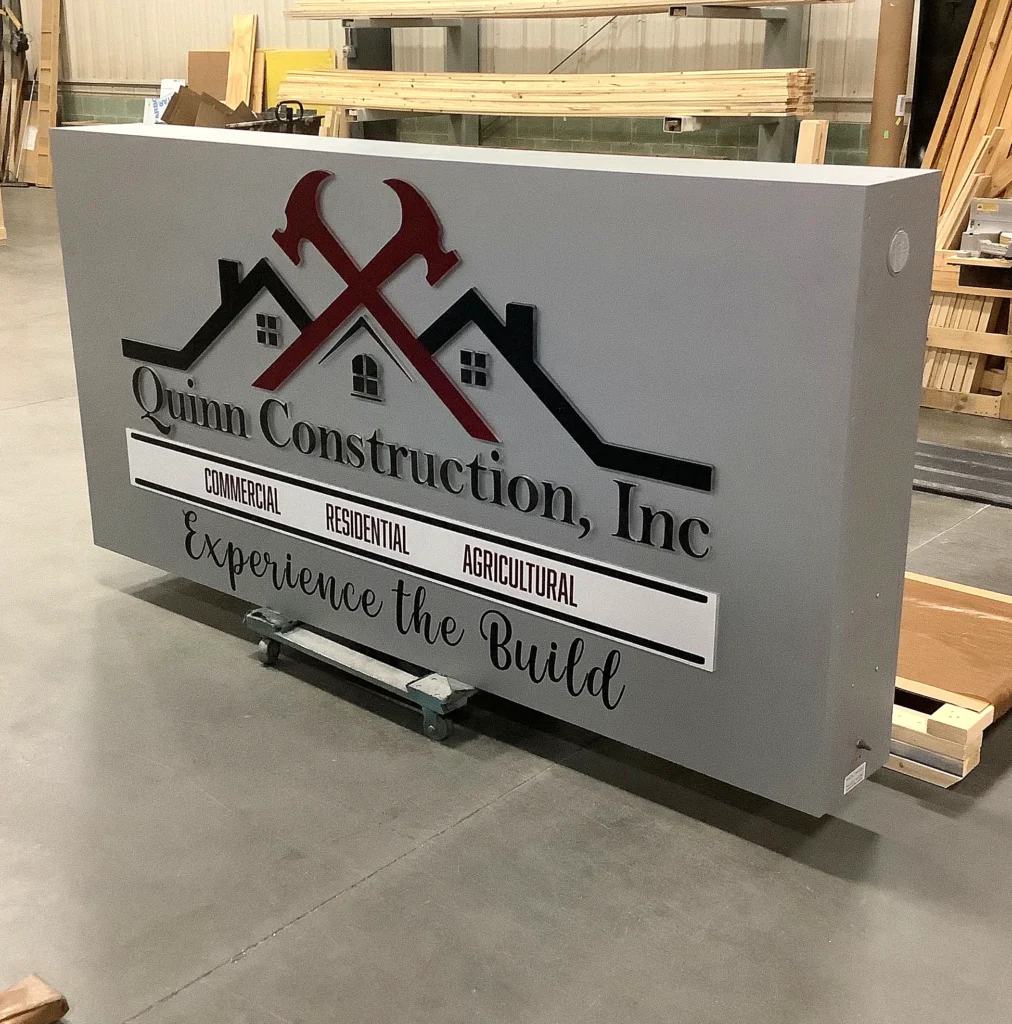
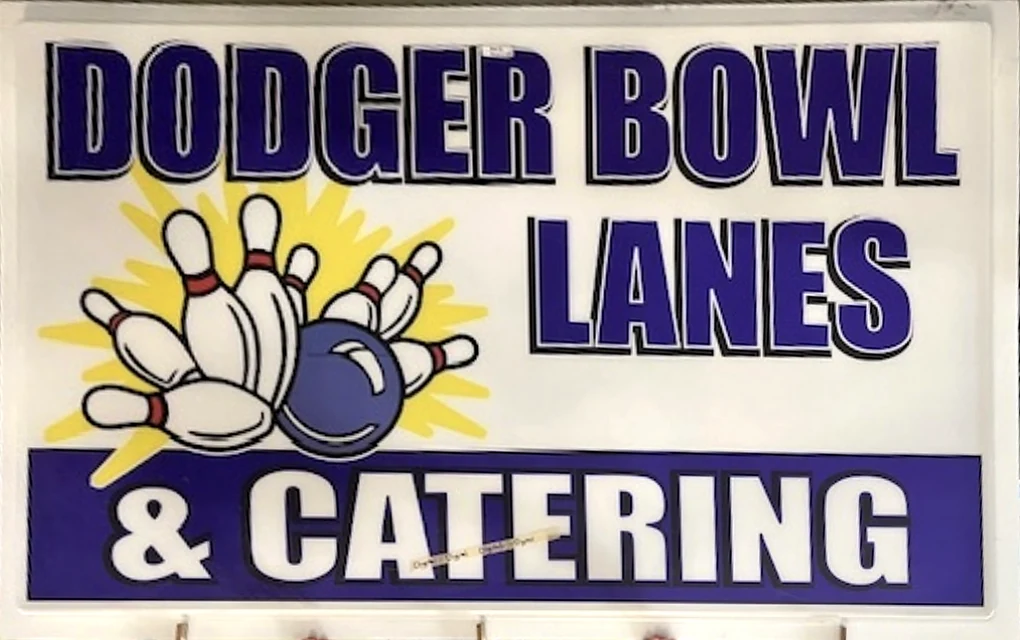
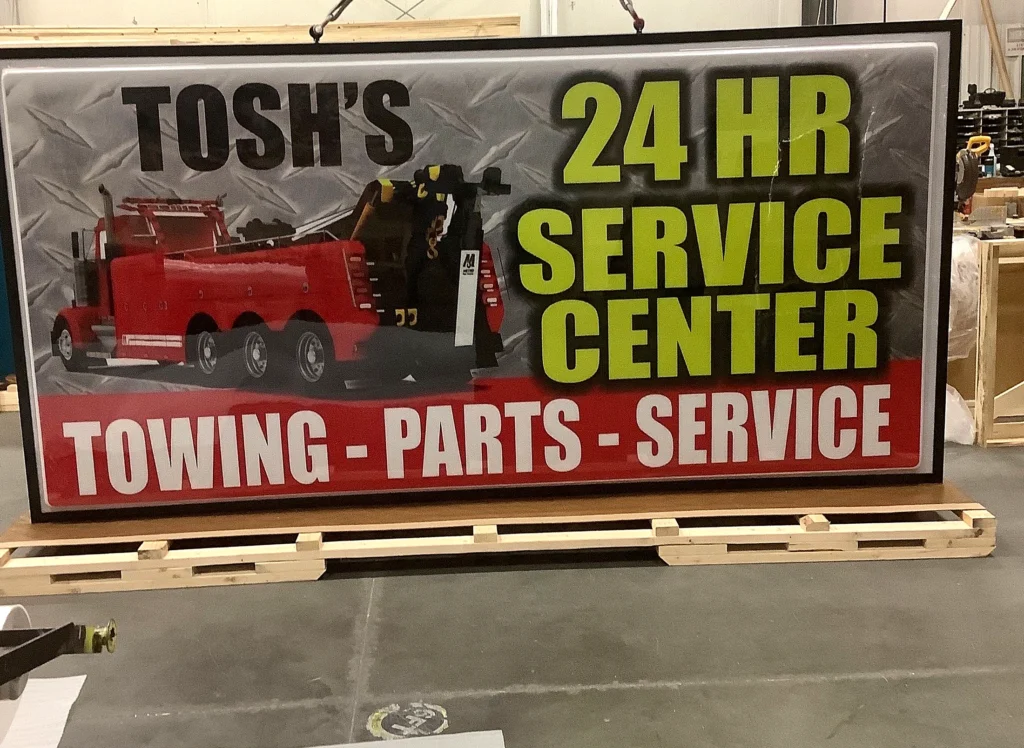
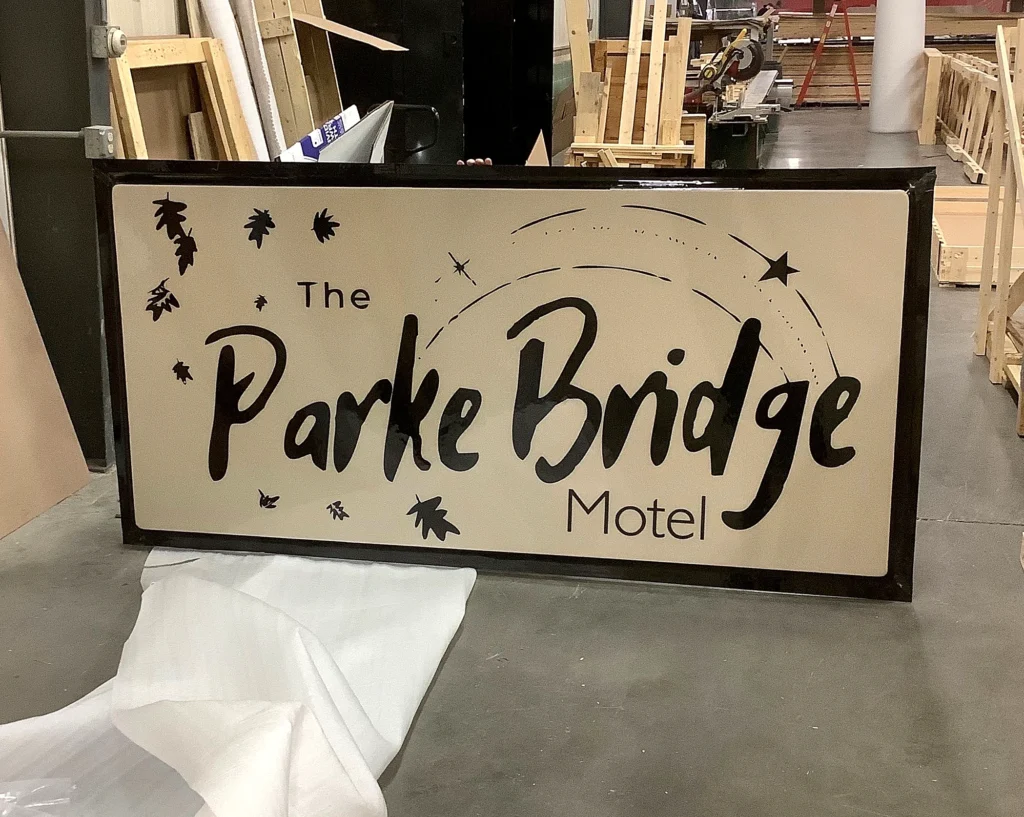
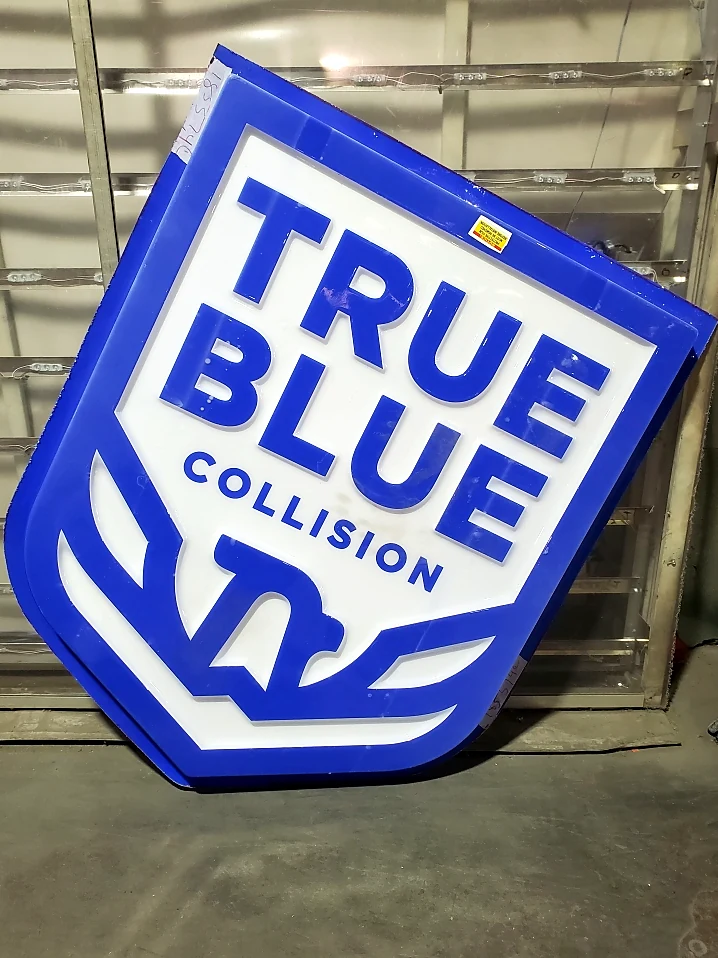
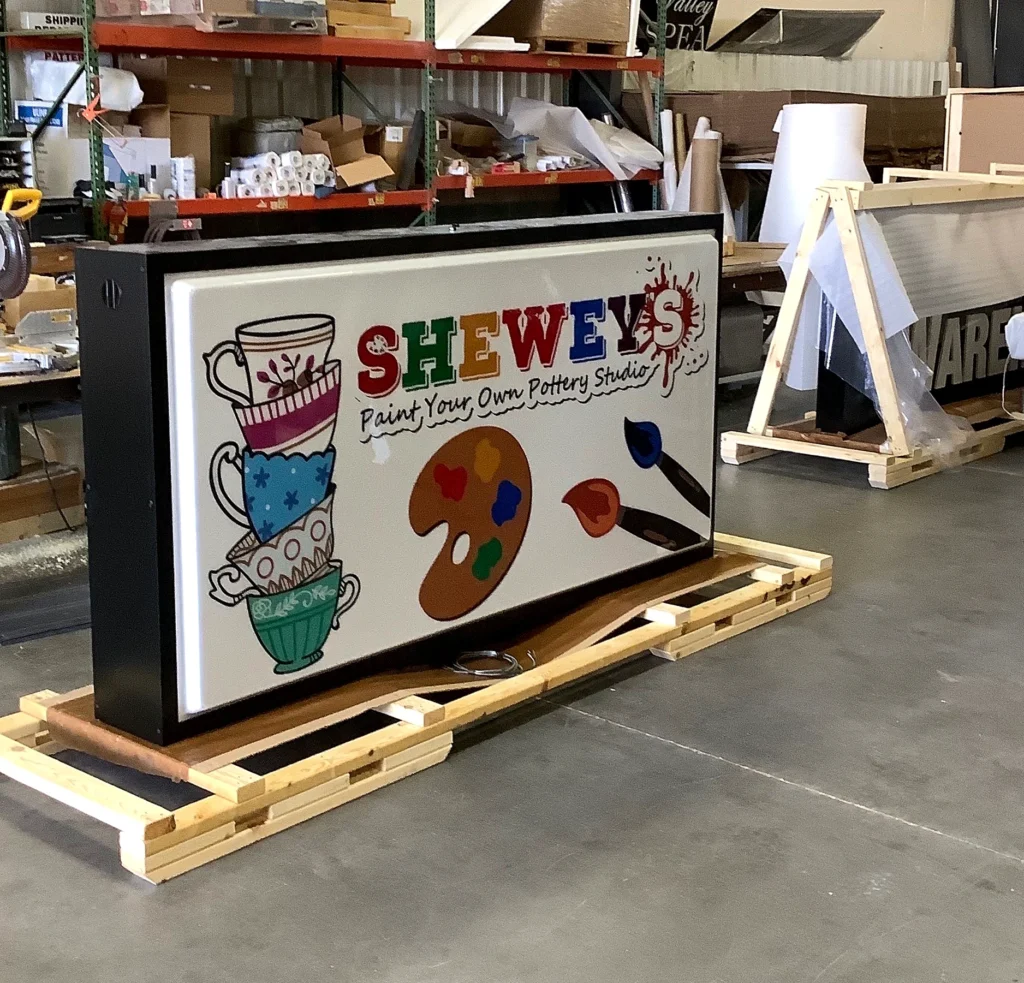
One city's code defines a cabinet sign as an internally lit sign whose removable face is enclosed on all edges by a metal cabinet. Cabinet signs can be single- or double-faced, rectangular or shaped to a logo, and lit through the whole face or only through letters routed out of an opaque face.
That definition is from Gig Harbor, Washington, which adds that a cabinet sign may be multi-sided. A double-faced cabinet puts two faces back to back for traffic from both directions; the USSC model sign code counts only one side toward sign area.
The face decides how the sign looks at night. A full translucent face glows edge to edge. A routed face is an opaque aluminum panel with the copy cut out and backed with acrylic, sometimes as push-through letters, so only the name and logo light. Charleston, South Carolina's design review policy requires that construction for internally lit signs, and Portsmouth, Rhode Island's guidelines call it the preferred method.
| Style | What lights up | Where it tends to fit | Watch for |
|---|---|---|---|
| Full translucent face | The whole face | Full-color logos and artwork | Some design-review districts discourage fully lit faces |
| Routed or push-through face | Letters and logo only | Design-review districts and darker backgrounds | A copy change means cutting a new face |
| Double-faced cabinet | Two faces, back to back | Poles, pylons and projecting mounts seen from both directions | Both faces need artwork |
| Shaped cabinet | A face cut to the logo outline | Logos with a strong shape | How your code measures the area |
Sources: City of Gig Harbor, WA - Ordinance No. 1192 amending the sign code, GHMC 17.80 (one city's example); USSC Foundation - Model On-Premise Sign Code (a model, not law); City of Charleston, SC - Design Review Board Policy Statement for Signs (updated May 2026; one city's example); Town of Portsmouth, RI - Code Chapter 148, Design Guidelines, Article VIII Signage Design Guidelines (one town's example)
Polycarbonate, acrylic or flex face: which suits your sign cabinet?
Choose polycarbonate where impact and vandalism are the main risk, acrylic where clarity and a hard surface matter most, and a flexible face for very large openings. One plastics distributor sums it up: acrylic for clarity and UV resistance, polycarbonate when impact resistance and vandal protection are priorities.
The same comparison notes that acrylic has the harder, more scratch-resistant surface. GE's data sheet for Lexan SG305, a polycarbonate sign sheet, describes it as combining high impact resistance with optical clarity for protection against vandalism.
Flexible faces work differently. 3M describes its Panaflex 645EI facing as a flexible, translucent sign material for internally lit and front-lit signs that is tensioned in a cabinet or frame, and it calls for heat tensioning when installation temperatures are below 68 degrees F.
Suntronix offers a limited warranty on qualifying Lexan lighted sign faces. Vandalism is excluded, and coverage is confirmed in the proposal.
| Material | Main strength | Trade-off |
|---|---|---|
| Polycarbonate (Lexan is one brand) | Impact and vandal resistance | Softer surface than acrylic |
| Acrylic | Clarity, UV resistance, harder surface | Less impact resistance than polycarbonate |
| Flexible face (for example, 3M Panaflex) | Flexible, tear-resistant sheet tensioned in the frame | Installation temperature limits without heat tensioning |
Sources: Interstate Plastics (plastics distributor) - Polycarbonate vs. Acrylic: Which Is Right for You? (Rev 4, Sept. 24, 2025); GE Structured Products - Lexan SG305 Sheet for Signs, product data sheet; 3M - Panaflex Enhanced Image Sign Facing 645EI, product page
Should a lighted cabinet sign use LED or fluorescent lighting?
LED, for most new cabinets. The U.S. Department of Energy notes that fluorescent lamps depend on a ballast and other parts that can fail, and that LED products can fade rather than burn out. DOE has also described cold environments as optimal for LED luminaires, and its refrigerated-case fact sheet notes that LEDs contain no mercury.
Failure behavior matters on a sign people judge at night. DOE explains that some LED products fail suddenly while others exhibit parametric failure, meaning they stop producing enough or good enough light. LED life is usually rated to L70, the point where output has dropped to 70 percent of the original.
Heat is the weak spot. DOE notes that a driver's useful life is strongly dependent on operating temperature, so ask how the cabinet sheds summer heat. The cold-weather point comes from DOE's work on refrigerated display cases, not signs.
If you convert an old fluorescent cabinet, remember that the National Electrical Code requires electric signs to be listed and installed per their listing. The Lighted Signs page covers retrofits.
Sources: U.S. Department of Energy - Lifetime and Reliability, Solid-State Lighting Technology Fact Sheet; U.S. Department of Energy - Technology Specification Project: LEDs for Refrigerated Display Cases, fact sheet; EC&M - NEC Rules for Electric Signs and Outline Lighting (NEC Article 600; March 18, 2013)
Where can a cabinet sign be mounted?
On a building wall, projecting from it, on one or two poles, inside a pylon cover, or in a monument base. The cabinet works the same way in each case. What changes is the structure, the clearance underneath, how drivers see it, and how your code counts and limits it.
Orientation affects whether drivers notice the sign at all. In research summarized by the United States Sign Council, perpendicular signs were almost never missed while test drivers drove past 30 percent of parallel signs, even though the parallel signs were two to three times larger. A double-faced cabinet on a pole or bracket faces traffic; a wall cabinet only does if the wall faces oncoming traffic.
Codes limit some mounts. Gig Harbor, Washington, for example, does not allow projecting signs in one of its sign areas to be cabinet-type or internally lit. The USSC model sign code calls for at least 8 feet under a sign that extends more than 12 inches over a sidewalk, and 14 feet where vehicles travel or park.
| Mount | Typical use | Check first |
|---|---|---|
| Wall | Storefront identification | Power at the wall; the NEC calls for a sign outlet at each tenant entrance |
| Projecting | Downtown storefronts seen along the sidewalk | Some codes bar cabinet-type projecting signs; 8 ft clearance over walkways in the USSC model code |
| Pole | Roadside identity for a single business | 14 ft clearance where vehicles pass; the structure's condition if reused |
| Pylon or monument | Faster roads, multi-tenant sites, entrances | See the pylon and monument guides |
Sources: City of Gig Harbor, WA - Ordinance No. 1192 amending the sign code, GHMC 17.80 (one city's example); USSC Foundation - Model On-Premise Sign Code (a model, not law); EC&M - NEC Rules for Electric Signs and Outline Lighting (NEC Article 600; March 18, 2013); United States Sign Council - Sign Legibility Rules of Thumb (2006)
How big should a light box sign be for your road?
Start from letter height, then size the cabinet around it. USSC rules of thumb call for capital letters of about 12 inches at 30 mph on a two-lane road and about 22 inches at 45 mph on four lanes, with open background filling at least 60 percent of the face.
The method multiplies USSC's viewer reaction time by speed in feet per second (mph x 1.47) to get the reading distance, then divides by a legibility index of 30, or one inch of capital letter per 30 feet. All-caps copy needs about 15 percent more height.
Know what your code counts. The USSC model code measures a cabinet sign by the outer dimensions of the frame or cabinet, so borders count against your allowance, yet Portsmouth, Rhode Island's guidelines ask for an ample border around letters. When space is tight, cut words, not letter height.
| Road and speed | USSC reaction time | Distance covered in that time | Capital letter height |
|---|---|---|---|
| 25 mph, two to three lanes | 8 seconds | About 294 ft | About 10 in |
| 30 mph, two to three lanes | 8 seconds | About 353 ft | About 12 in |
| 45 mph, four to five lanes | 10 seconds | About 662 ft | About 22 in |
| 55 mph, multi-lane | 11 to 12 seconds | About 889 to 970 ft | About 30 to 32 in |
Sources: USSC Foundation - Model On-Premise Sign Code (a model, not law); Town of Portsmouth, RI - Code Chapter 148, Design Guidelines, Article VIII Signage Design Guidelines (one town's example); United States Sign Council - Sign Legibility Rules of Thumb (2006)
Is it worth refacing an existing sign cabinet?
Often, when the cabinet, frame and wiring are sound. A new face is usually the smallest change a code allows: the USSC model sign code lets removable faces in a cabinet sign be changed by right. Local rules can be stricter, so confirm with your city before ordering a face.
Cities differ. Charleston, South Carolina's design review policy lets a nonconforming freestanding sign be refaced but requires the whole sign to conform for any other change. On building facades it goes further: cabinet or box signs must be removed and replaced with another sign type rather than refaced. Monticello, Iowa needed a 2021 council resolution to let one business replace the face on a nonconforming pole sign, and Panguitch, Utah requires a permit to replace any sign.
A Suntronix representative can review the existing cabinet at your location. Check what a new face cannot fix:
- Rust at the seams, the bottom of the cabinet and the mounting points.
- Drain holes, which the NEC requires on signs in wet locations.
- The lighting: old lamps and ballasts, or LED sections that have dimmed.
- The listing label and a disconnect within sight of the sign.
- Whether the sign is nonconforming, and whether the cabinet still fits your name and road speed.
Sources: USSC Foundation - Model On-Premise Sign Code (a model, not law); City of Charleston, SC - Design Review Board Policy Statement for Signs (updated May 2026; one city's example); EC&M - NEC Rules for Electric Signs and Outline Lighting (NEC Article 600; March 18, 2013); City of Monticello, IA - Resolution 2021-75, pole sign extension (July 19, 2021; one city's example); Panguitch City, UT - Signage Permit and sign requirements (one city's example)
What permits and electrical work does a cabinet sign need?
Expect a sign permit and an electrical connection that follows the National Electrical Code. Electric signs must be listed and installed per their listing, with a disconnect within sight of the sign. Signs in wet locations must be weatherproof and have drain holes. Local permit offices decide what they inspect.
Within sight means visible and not more than 50 feet away, as EC&M summarizes the NEC definition. A commercial building or occupancy accessible to pedestrians needs a sign outlet at each tenant entrance, supplied by its own branch circuit rated at least 20 amps. The USSC model sign code also asks for the sign's listing label number on the permit application.
Distance to power drives cost on freestanding mounts. HomeGuide puts underground power runs at $10 to $25 per foot installed, and HomeAdvisor suggests budgeting $400 to $2,500 for permits, with more set aside for electrical wiring.
Suntronix provides the drawings and specifications a permit application needs, and can coordinate permitting and installation for a fee or hand them to your own installer.
Sources: USSC Foundation - Model On-Premise Sign Code (a model, not law); EC&M - NEC Rules for Electric Signs and Outline Lighting (NEC Article 600; March 18, 2013); HomeAdvisor - How Much Does Commercial Sign Installation Cost? (updated June 20, 2026); HomeGuide - How Much Does a Business Sign Cost? (Dec. 19, 2023)
What do cabinet signs cost?
HomeAdvisor's national cost guide puts outdoor lighted signs at about $500 to $5,000, and high-end commercial signs with installation at about $150 to $300 per square foot. These are third-party estimates, not Suntronix pricing. Size, face material, lighting, mounting height, structure and electrical work move the number.
Suntronix prices each custom project around the site; there is no published Suntronix price list. Financing may be available for qualifying projects.
- Cabinet size and whether it is single- or double-faced.
- Face style: translucent, routed or push-through, or flexible.
- Mounting, plus engineering and a footing for a new freestanding structure.
- Wiring distance from the electrical panel, and permits.
| Item | Published range | Source |
|---|---|---|
| Outdoor lighted sign | $500 to $5,000 | HomeAdvisor |
| High-end commercial sign, with installation | About $150 to $300 per sq ft | HomeAdvisor |
| Pylon and pole signs, most sizes | $20,000 to $100,000 | HomeAdvisor |
| Permits | $400 to $2,500 | HomeAdvisor |
| Structural engineering plans | $500 to $3,000 | HomeGuide |
| Underground power run | $10 to $25 per foot | HomeGuide |
Sources: HomeAdvisor - How Much Does Commercial Sign Installation Cost? (updated June 20, 2026); HomeGuide - How Much Does a Business Sign Cost? (Dec. 19, 2023)