In this guide
A typical business sign costs a few thousand dollars installed. HomeGuide’s national estimate for an average business sign is $2,000 to $5,000 installed, while large lighted pylons and LED message centers can run into five or even six figures. What you pay depends on size, lighting, structure, electrical work, permits and installation access.
Size, materials and illumination matter, but so do the mounting surface, electrical supply, installation access and supporting structure. Two signs that look similar in a photograph can have very different installed costs.
Suntronix prices custom projects around the actual site and scope, and there is no published Suntronix price list. The ranges below are third-party national estimates, not Suntronix pricing. Use them to sanity-check a budget, then get a quote that tells you exactly what you are buying and which responsibilities remain yours.
What do different types of business signs cost?
National cost guides publish installed-price ranges by sign type. They were written at different times, group sign types differently, and do not always include the same work, so treat them as a rough frame rather than a price.
| Sign type | HomeGuide (Dec. 2023) | HomeAdvisor (updated June 2026) | Notes |
|---|---|---|---|
| Channel letters | $2,000 to $20,000+ | $4,000 to $20,000, including installation | HomeAdvisor says reverse (halo-lit) letters can cost up to 30% more. |
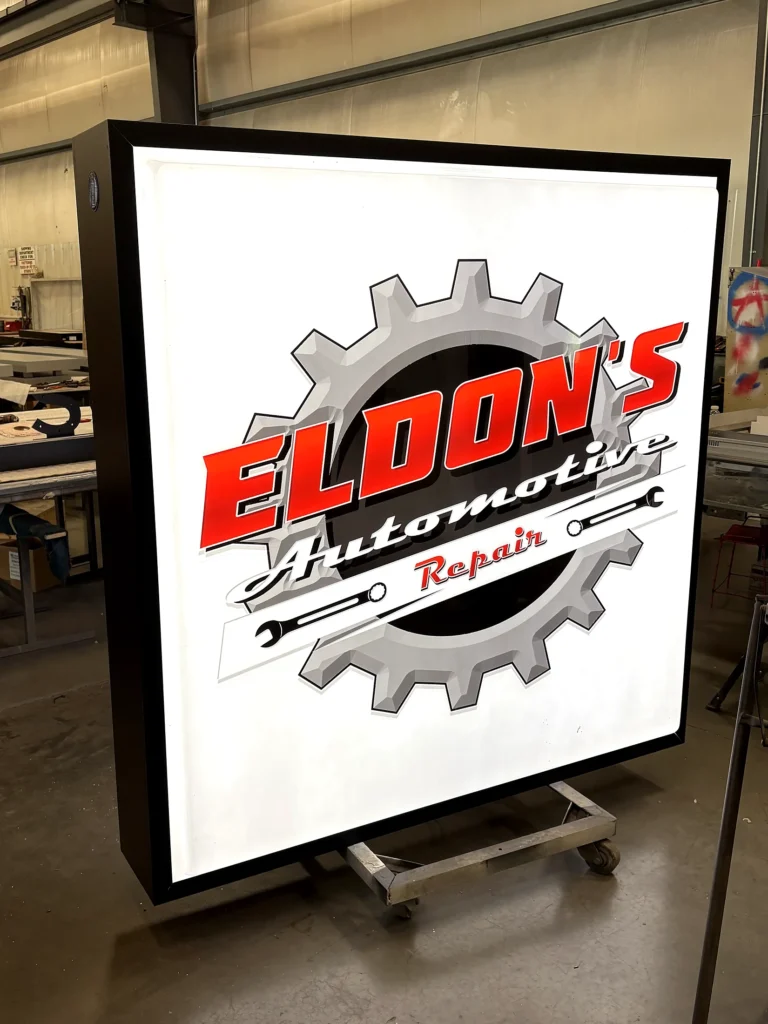
| Lighted cabinet sign | Not listed as its own category | $500 to $5,000 (outdoor lighted signs) | Poles, bases and wiring can add to the cabinet price. |
| Monument sign | $5,000 to $20,000+ installed | $5,000 to $20,000 | HomeGuide notes codes often require stamped structural drawings for monuments. |
| Pylon sign | $10,000 to $100,000+ installed; up to $200,000 for a lighted, double-sided highway pylon | $20,000 to $100,000 (pylon and pole signs) | Height, face area and engineering drive the spread. |
| LED message center | $5,000 to $10,000+ (digital / electronic message signs) | $750 to $30,000 (outdoor LED and digital signs) | AVIXA, the audiovisual industry association, notes that pixel density and cost rise as pixel pitch gets finer. |
| Indoor digital display | Not listed | Not listed | No neutral national estimate found. Size, pixel pitch, mounting and software set the price; ask for each to be listed separately. |
Why are the ranges so wide? A small non-illuminated letter set and a 30-foot lighted pylon are both “business signs.” Within one type, size, lighting, the structure and the site move the price more than anything else.
Other costs that show up on a sign quote
The sign itself is only part of an installed project. These items are often priced separately, and the same national guides publish ranges for them.
| Item | Published range | Source |
|---|---|---|
| Sign permit | $400 to $2,500 | HomeAdvisor |
| Electrical wiring to the sign | $560 to $2,300 | HomeAdvisor |
| Underground power run | $10 to $25 per foot installed | HomeGuide |
| Structural engineering plans | $500 to $3,000 | HomeGuide |
| Installation labor | $181 to $804, averaging $464 | HomeAdvisor |
Distance is the quiet cost driver. A freestanding sign 150 feet from the electrical panel needs a trench and conduit all the way there, and at $10 to $25 per foot that run alone works out to roughly $1,500 to $3,750.
Start with the complete installed project
Before comparing numbers, ask whether each proposal covers the same finished result. A fabrication-only quote is not directly comparable with one that also includes delivery, removal of the old sign, equipment, electrical connections and installation.
For example, imagine two shops ordering the same illuminated cabinet. One has a suitable existing support, nearby power and straightforward access. The other needs a new support, site work and electrical service. The cabinet could be identical; the projects are not. This is an illustrative comparison, not a Suntronix price estimate.
| Scope item | What to confirm |
|---|---|
| Design and fabrication | Dimensions, materials, colors, illumination, artwork revisions and the approved proof. |
| Structure and mounting | Wall attachments, raceway, supports, foundation work and any engineering included. |
| Electrical work | Who brings power to the sign, makes connections and provides access for service. |
| Delivery and installation | Freight, unloading, lifting equipment, installer labor, old-sign removal and disposal. |
| Approvals | Who handles property approval, permit applications, fees and required documents. |
| After installation | Training, warranty coverage, exclusions and the process for requesting service. |
The specifications that change the price
Size and construction. Larger signs need more than additional face material. Cabinets, attachments and supports also need to suit the finished assembly. Custom shapes and complex artwork can add fabrication steps. Begin with the size needed for the customer’s viewing distance, then refine the design.
Lighting. Non-illuminated letters, front-lit channel letters, halo-lit letters and internally illuminated cabinets use different components and installation approaches. Compare the lighting effect you want with the wall conditions and service access available.
Digital equipment. A programmable LED display adds decisions about pixel pitch, display dimensions, control software, communication and operator training. Finer pitch costs more because pixel density rises, so match it to how close people actually stand or drive. Ask for the actual specifications and included services. A screen’s outside dimensions alone are not a complete comparison.
Structure and engineering. Freestanding signs catch wind, and many codes require stamped structural drawings for monuments and pylons. The footing is designed for local wind loads, so the same sign can need a different foundation in a different county.
The site. Working height, mounting conditions, access for equipment and the state of an existing structure can change the plan. Reusing a sign support may be possible, but a photograph cannot establish its suitability. Resolve that question before treating reuse as a saving.
How to compare two sign quotes fairly
Put the proposals side by side and mark each scope item as included, excluded or unclear. Ask both suppliers to explain the unclear items in writing. Pay particular attention to who coordinates the installer when fabrication and installation are supplied separately.
Compare dimensions, materials and lighting as carefully as the total. Then compare delivery assumptions, completion milestones and the conditions that could change the price. A useful question is: “What could you discover at the site that would require a revised proposal?”
Read the warranty as a description of coverage rather than a headline duration. Ask which components are covered, who handles a claim, and how labor, travel and removal or reinstallation are treated. Coverage depends on the specific product and project terms.
Where to simplify without weakening the sign
If the first proposal is outside the budget, revisit the job the sign needs to do. Simplifying secondary copy or an intricate custom shape may be more useful than shrinking the business name until it is difficult to read. A permanent identity sign may be enough when there is no real need to change messages.
A new face in a sound existing cabinet is often the lowest-cost real improvement. Check first whether your city requires a permit for a replacement face; some do.
For a property with several entrances or a large building, discuss priorities instead of treating every sign as equally urgent. A phased scope can be worth considering, provided the first phase still gives customers clear identification and a workable arrival route.
Send these details for a useful estimate
- The installation address and the location on the property.
- Wide photos from the road or parking lot, plus close photos of the mounting area.
- Approximate sign and wall dimensions, clearly marked as estimates if unmeasured.
- Your logo files and any property sign criteria. The Suntronix quote form accepts JPG, PNG or PDF files up to 5 MB.
- Whether an existing sign, support or electrical supply is involved, and roughly how far the nearest electrical panel is from the sign location.
- Your preferred timing, budget context and who will coordinate installation.
Photos help start the discussion. They do not replace the measurements or site checks needed to finalize the work. Suntronix’s site-survey and installation-support process connects the proposed sign with the conditions that affect its build and installation. Suntronix can coordinate permitting and installation for a fee, or provide project information to your own installer.
Frequently asked questions
How much does a business sign cost on average?
HomeGuide’s national estimate is $2,000 to $5,000 installed for an average business sign, with a very wide spread by type. Treat any national figure as a third-party estimate; a quote for your site is the only reliable number.
Can I get a quote before a site survey?
Initial information can support a preliminary discussion. Ask which assumptions the estimate uses and what needs verification before the price and scope are finalized.
Is installation always included?
Do not assume it is. The proposal should state who provides installation, which work is included and what the customer or another contractor must arrange.
Are permits included in the sign price?
Not always. HomeAdvisor puts sign permits at $400 to $2,500 nationally, and some signs also need engineering. Ask whether permit fees, drawings and the application work are in the quote or billed separately.
Should I choose the lowest quote?
First confirm equivalent specifications and responsibilities. A lower fabrication price can leave more site work outside the quoted scope.
Explore Suntronix sign options, then send your site details for a project quote.
Sources
Cost ranges are third-party national estimates, accessed September 23, 2026. They are not Suntronix pricing.
- HomeGuide, “How Much Does a Business Sign Cost?” (Dec. 19, 2023): average installed cost, channel letter, digital, monument and pylon ranges, engineering and underground power costs, stamped-drawing note.
- HomeAdvisor, “How Much Does Commercial Sign Installation Cost?” (updated June 20, 2026): installation labor, permit and wiring costs, channel letter, lighted, pylon and pole, monument and LED ranges.
- AVIXA Xchange, “What is Pixel Pitch? How to Calculate Pixel Pitch”: pixel pitch, pixel density and cost.
- International Code Council, “Demystifying Loads: 2024 IBC and ASCE 7-22”: wind loads determined under ASCE 7 (IBC Section 1609.1.1).
- Panguitch City, Utah, Signage Permit: one city’s example of a permit required for sign alteration or replacement.