What signs does a bank or credit union branch need?
Most branches need three layers: identity from the road, usually a monument or pylon plus building letters; wayfinding on the lot for the entrance, drive-up lanes and ATM; and the required federal insurance signs inside where deposits are taken. Plan all three together so they share one look and do not compete.
Identity signs carry the name to drivers. USSC strongly recommends that sign copy sit no less than seven feet above grade, because other vehicles can block copy at or below five feet. That matters for low monuments at busy branches.
Wayfinding signs work at parking-lot speed. They tell drivers which lane is the drive-up, which is the ATM and where to exit.
Sources: USSC Foundation - On-Premise Signs Guideline Standards (2018)
Which FDIC and NCUA signs do bank signs have to include?
The required official signs go inside. Banks must display the FDIC official sign at each teller window or station where insured deposits are usually received, at least 7 by 3 inches in black on gold, or in some cases one larger sign legible across the teller area. Credit unions must display the NCUA official sign at each station or window where insured funds are normally received.
Both regulators exempt signs or plates in the office or attached to the building from the official advertising statement, such as "Member FDIC." Read that wording closely: a freestanding monument, or a message center running deposit ads, is not plainly covered by an exemption for signs attached to the building, so have compliance review it.
ATMs have their own rule. The FDIC calls for its official digital sign on an ATM's initial screen, but ATMs placed into service on or before April 1, 2027 may show the physical official sign instead. This is a general summary, not legal advice.
Sources: Electronic Code of Federal Regulations via Cornell LII - 12 CFR 328.3, Official sign and signage requirements for insured depository institution premises; Electronic Code of Federal Regulations via Cornell LII - 12 CFR 328.6, Official advertising statement requirements; Electronic Code of Federal Regulations via Cornell LII - 12 CFR 740.4, Requirements for the official sign (NCUA); Electronic Code of Federal Regulations via Cornell LII - 12 CFR 740.5, Requirements for the official advertising statement (NCUA); Electronic Code of Federal Regulations via Cornell LII - 12 CFR 328.4, Signage requirements for ATMs and like devices (as amended Jan. 29, 2026)
Can credit union signs and bank signs advertise rates?
Yes, with care. Under Regulation DD, a rate of return in an advertisement must be stated as an annual percentage yield, and other disclosures follow. Outdoor media such as billboards get a partial exemption, not a full one. Credit unions follow the parallel NCUA rule in Part 707. Have compliance approve every rate frame.
The outdoor-media exemption drops some disclosures, such as variable-rate notices and the effect of fees, but not others. An ad that states an APY must still give the minimum balance needed to earn it, and a time account must state its term. Design rate frames with room for that text.
Signs inside the premises are exempt from most of these rules, but a rate shown there must be an APY, with a statement telling customers to contact an employee about fees and terms. A lobby screen is the simpler place for a full rate board. This is a general summary, not legal advice.
Sources: Consumer Financial Protection Bureau - Regulation DD, 12 CFR 1030.8 Advertising; Electronic Code of Federal Regulations via Cornell LII - 12 CFR 707.8, Advertising (NCUA Truth in Savings)
Should a branch sign still show time and temperature?
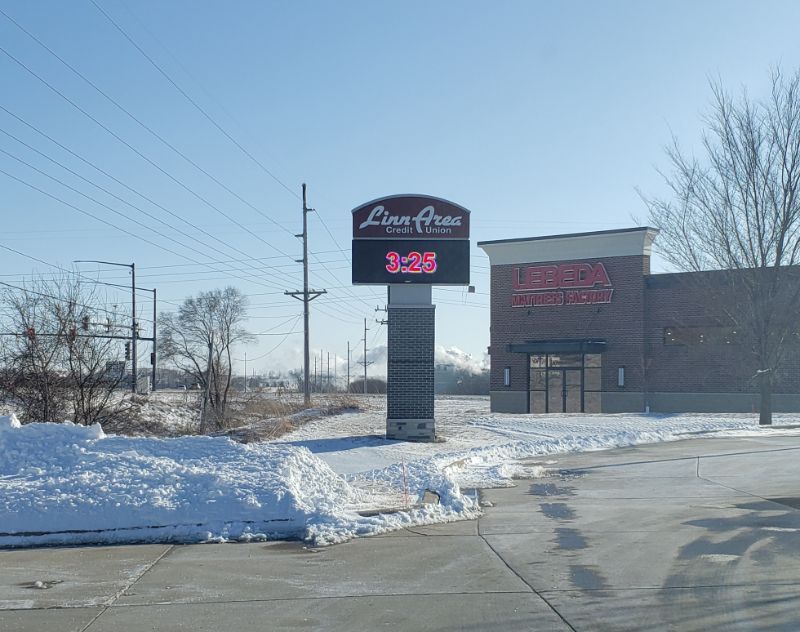
If your community relies on it, keep it. A message center can show time and temperature between other frames. In Jefferson City, Missouri, the Board of Adjustment approved a bank's three-sided message center in place of its 30-foot pylon, so long as the bank kept showing time and temperature for residents.
That project planned three screens, each 4 feet tall and 9 feet wide: one toward the highway, one toward the street and one toward drive-thru customers. Each face reached a different audience, and the content can follow suit. Ask your permit office how your code treats time and temperature displays.
How should drive-up and ATM lanes be signed?
With short, lighted signs that face the approaching driver: lane names or numbers, ATM and drive-up arrows, clearance height and open or closed indicators. Keep words few and arrows large. Wall-mounted signs are easy to miss; in a USSC study, drivers passed 30 percent of signs parallel to the road even while looking for them.
Put directional signs at decision points: the entrance, the split between lobby parking and the drive-up, and each lane entry. Lighted directionals help after hours, when the ATM may be the only service open.
Post the clear height at the canopy entrance, and measure it on site rather than from old drawings.
Sources: United States Sign Council - Sign Legibility Rules of Thumb (2006)
Monument sign, channel letters or both for a branch?
Both, at many branches. A monument at the entrance names the branch for drivers and can hold a message center. Channel letters on the building confirm the destination and read well from the parking lot. National guides put monument signs at $5,000 to $20,000 or more and channel letters at $4,000 to $20,000.
Those are third-party national estimates, not Suntronix pricing. Most cities require permits for business signs over a certain size or height. Suntronix provides the drawings and specifications a permit application needs, and installation can be coordinated for a fee, matched to an installer network, or handed to your preferred local installer.
Suntronix builds full-color LED message centers and includes on-site training for the software, communication setup and scheduling with every digital sign order. Keep night brightness modest: ISA research recommends staying within 0.3 footcandles over ambient light.
Sources: HomeGuide - How Much Does a Business Sign Cost? (Dec. 19, 2023); HomeAdvisor - How Much Does Commercial Sign Installation Cost? (updated June 20, 2026); International Sign Association - EMC Brightness Level Recommendations